Google Confirms May 2026 Core Update Complete After 12-Day Volatile Rollout
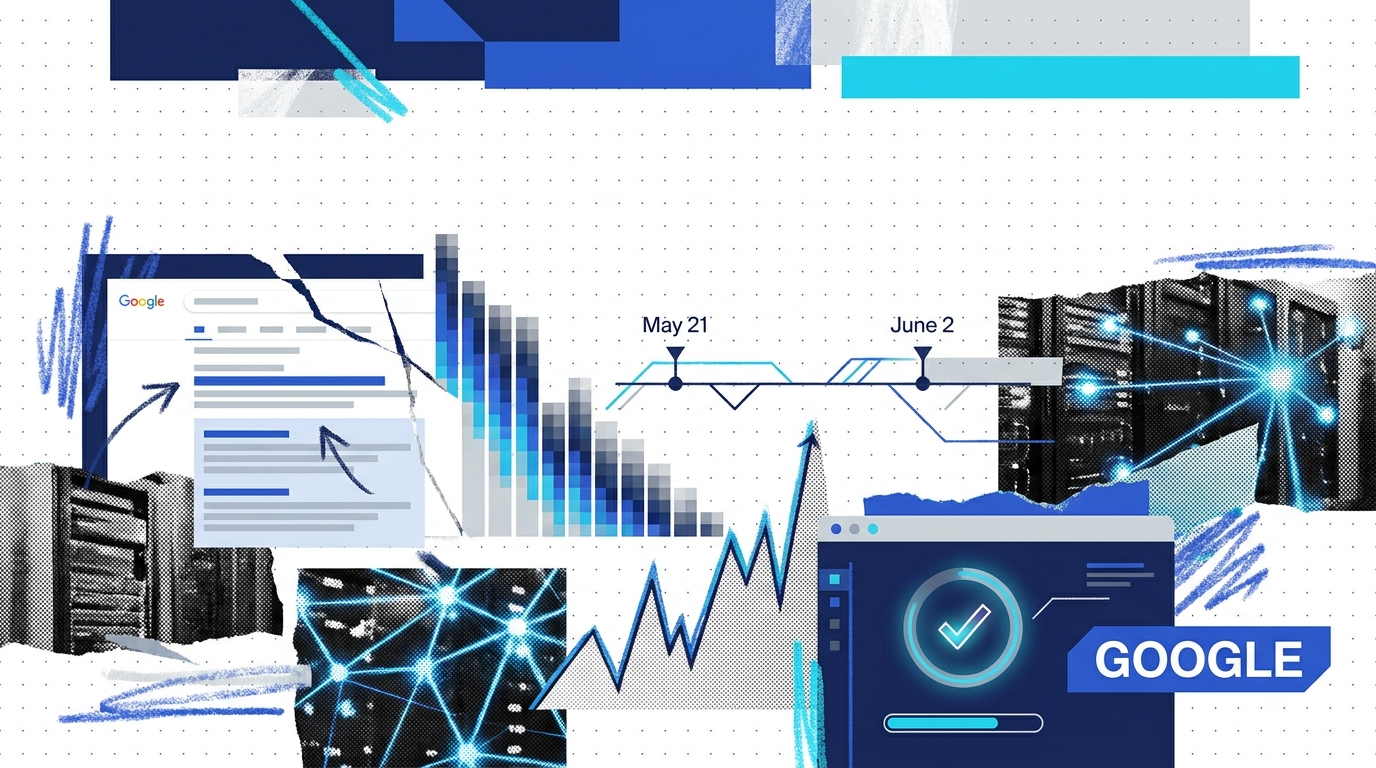
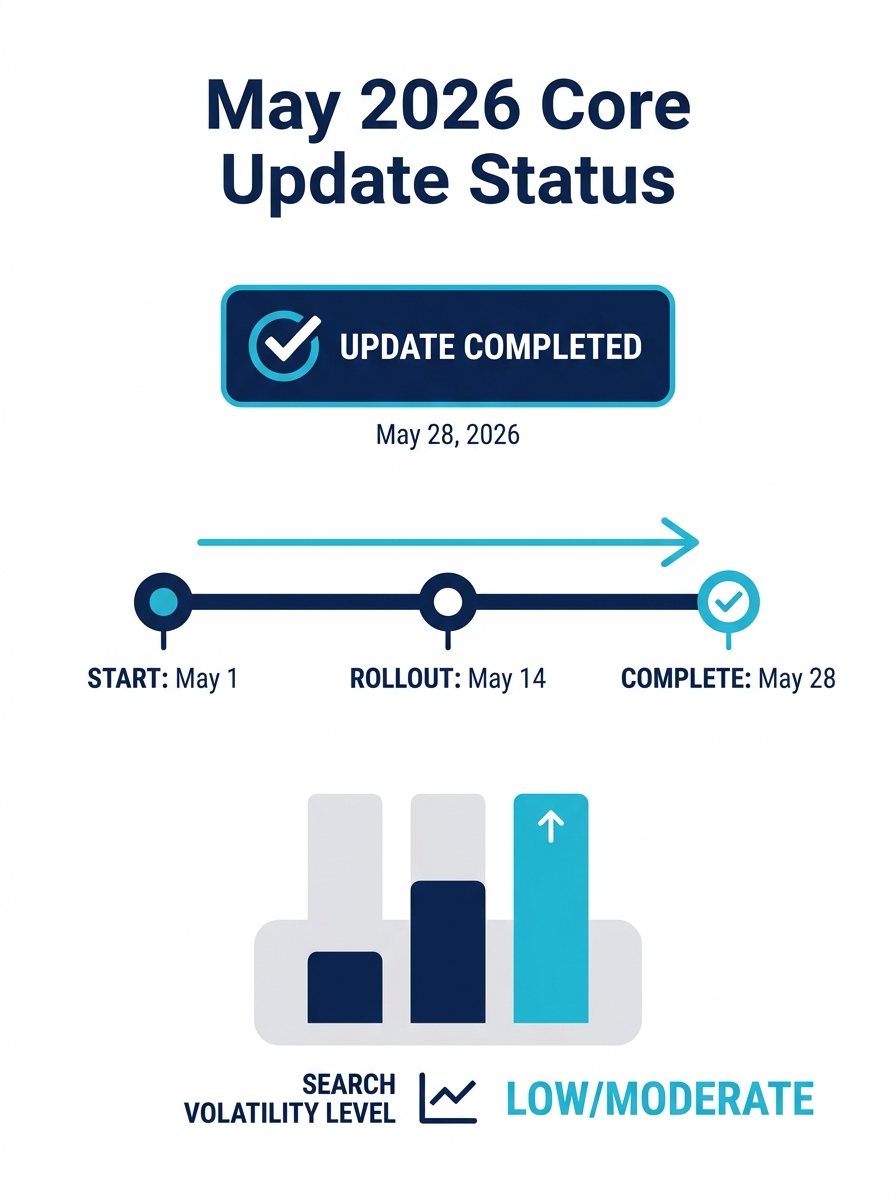
Google confirmed completion of its May 2026 core update on June 2, ending an 11-day, 21-hour rollout that practitioners described as significantly more impactful than the March update, according to the company’s Search Status Dashboard. The update launched May 21 at 8:40 AM PDT and finished June 2 at 5:40 AM PDT.
TL;DR: Google’s May 2026 core update concluded June 2 after nearly 12 days of elevated volatility, with the earliest clean comparison window in Search Console data arriving around June 9 under the company’s guidance.
The completion timeline closely mirrors the March 2026 core update, which finished in 12 days, but practitioner observations diverged sharply on impact. Glenn Gabe, SEO consultant at G-Squared Interactive, described the May update as “much more like a typical core update” compared to March, which he characterized as “meh,” according to reporting by Search Engine Journal. Lily Ray, VP of SEO Strategy and Research at Amsive, noted “a handful of sites started seeing big surges over the weekend” during the rollout.
Marie Haynes, founder of Marie Haynes Consulting Inc., connected the update’s timing to Google’s I/O announcements the same day, when the company launched Gemini 3.5 Flash as the model powering AI Search features. That temporal overlap complicates attribution for ranking shifts observed during the period.
Elevated Volatility Across Multiple Rollout Phases
Third-party tracking tools recorded heightened volatility at several distinct points during the 12-day window, rather than a single event at launch or completion. Gabe reported observing impact “across verticals and countries” by the first weekend. Movement registered across multiple days in the rollout, not just at start and finish, according to practitioner reports aggregated in the source article.
The volatility spike recorded on Saturday, May 30, five days before official completion, marked one of the most pronounced fluctuation periods. That pattern differs from core updates that show concentrated movement at rollout endpoints. Sites that saw ranking changes on May 24 may require different analysis than those affected on June 2.
Enterprise brands evaluating performance across portfolio properties need to account for this multi-phase movement when interpreting traffic shifts. A single-day comparison risks attributing organic change to the core update when the cause may lie elsewhere in Google’s parallel launches during the same window.
Google’s Clean-Comparison Guidance Pushes Analysis Window to June 9
Google’s core update documentation instructs site operators to wait at least one full week after completion before analyzing Search Console data, then compare that week against the week preceding the rollout start. That guidance places the earliest reliable comparison window around June 9 for the May update.
The recommendation reflects the algorithmic settling that continues after Google marks an update complete. Ranking distributions stabilize across the index over several days, making immediate post-completion snapshots unreliable for directional assessment. Marketing leaders briefing agency partners on post-update performance reviews should enforce this week-long buffer rather than requesting analysis on June 3.
The May update launched mid-I/O alongside AI Mode user-count disclosures and interface redesigns, creating layered variables in any traffic-attribution exercise. Separating core-update impact from AI-feature rollout effects requires controlled week-over-week comparison, not point-in-time ranking checks.
Four Confirmed Updates in 2026 Establish Tighter Cadence
The May core update marks the fourth confirmed search-related update Google listed on the Search Status Dashboard in 2026, and the second core update this year. Approximately six weeks separated the March core update’s April 8 completion and the May 21 launch.
The 2026 timeline shows:
- May 2026 core update: 12 days (May 21 to June 2)
- March 2026 core update: 12 days (March 27 to April 8)
- March 2026 spam update: under 20 hours (March 24 to March 25)
- February 2026 Discover core update: 22 days (February 5 to February 27)
- December 2025 core update: 18 days (December 11 to December 29)
The six-week interval between core updates represents Google’s tightest confirmed cadence in recent memory. Previous years saw quarterly or longer gaps between broad core updates. That compression leaves less recovery time for sites negatively affected by one update before the next begins, changing the risk calculus for enterprise SEO resource allocation.
Regulated APAC enterprises managing multi-country web estates face compounding optimization pressures under this pace. A site that drops 30% of organic visibility in March has six weeks to diagnose, prioritize, and implement fixes before May’s rollout introduces new variables. Marketing directors overseeing regional SEO programs need quarterly roadmaps that anticipate this rhythm rather than treating core updates as isolated events.
Reading Between the Lines
The May update’s volatility and practitioner consensus on impact—stronger than March—signal that Google’s core-ranking weights continue to shift aggressively in 2026 despite the company’s public messaging around stability. For Philippines-headquartered enterprises and APAC brands with PH operations, this matters less as a ranking-obsession story and more as a brief-and-oversee question: what should your SEO agency have ready by June 9?
The clean-comparison window Google prescribes isn’t arbitrary. It’s the earliest point at which Search Console data reflects settled post-update distribution rather than mid-rollout noise. Marketing leaders who green-light agency analysis before that date get preliminary reads that may reverse within 72 hours. The operational implication: hold the June 4-5 recap meeting, but treat it as directional until June 9 data confirms the pattern.
The tighter update cadence—six weeks between core rollouts—also changes how enterprises should structure SEO engagements. Annual audits with quarterly check-ins made sense when Google’s broad updates arrived three to four times per year. At current pace, that model leaves brands reacting to algorithmic shifts rather than anticipating them. Expect agencies to pitch continuous monitoring and monthly iteration cycles as the new table stakes for enterprise SEO in regulated verticals where organic visibility drives qualified pipeline at scale.