CMOs Establish “Human-Only Zones” to Protect Brand Storytelling as AI Content Deployment Reaches 51%

Marketing leaders are ring-fencing strategic creative work from full AI automation despite 51% of CMOs now actively deploying Generative AI tools across campaigns, according to guidance published by Wipro Global Chief Marketing Officer Ranjita Ghosh on TechRadar July 21, 2026. The framework responds to Canva research showing 70% of consumers can identify AI-generated advertisements because something feels missing.
TL;DR: CMOs are designating strategic visioning, emotional messaging, creative direction, crisis communications, and innovation work as “human-only zones” where AI automation is consciously resisted, even as Generative AI deployment crosses 51% among marketing executives.
CMO Adoption Rate Collides with Consumer Detection Ability
Generative AI deployment among chief marketing officers reached 51% in 2026, with AI-generated adverts now appearing across UK high streets from event promotion to product campaigns, Ghosh reported. Consumer ability to detect algorithmic content has kept pace: Canva data cited in the guidance shows seven in ten consumers recognize when advertisements were generated by AI rather than human teams.
The detection gap creates strategic risk for brands leaning on automation to scale content output. “When AI dictates the soul of a brand rather than simply serving as a sophisticated tool, the result is often a generic brand voice and weaker customer engagement,” Ghosh stated in the TechRadar piece.
Major global brands have attracted criticism for over-reliance on AI-generated creative work, the guidance notes, though specific company names were not disclosed in the published framework.
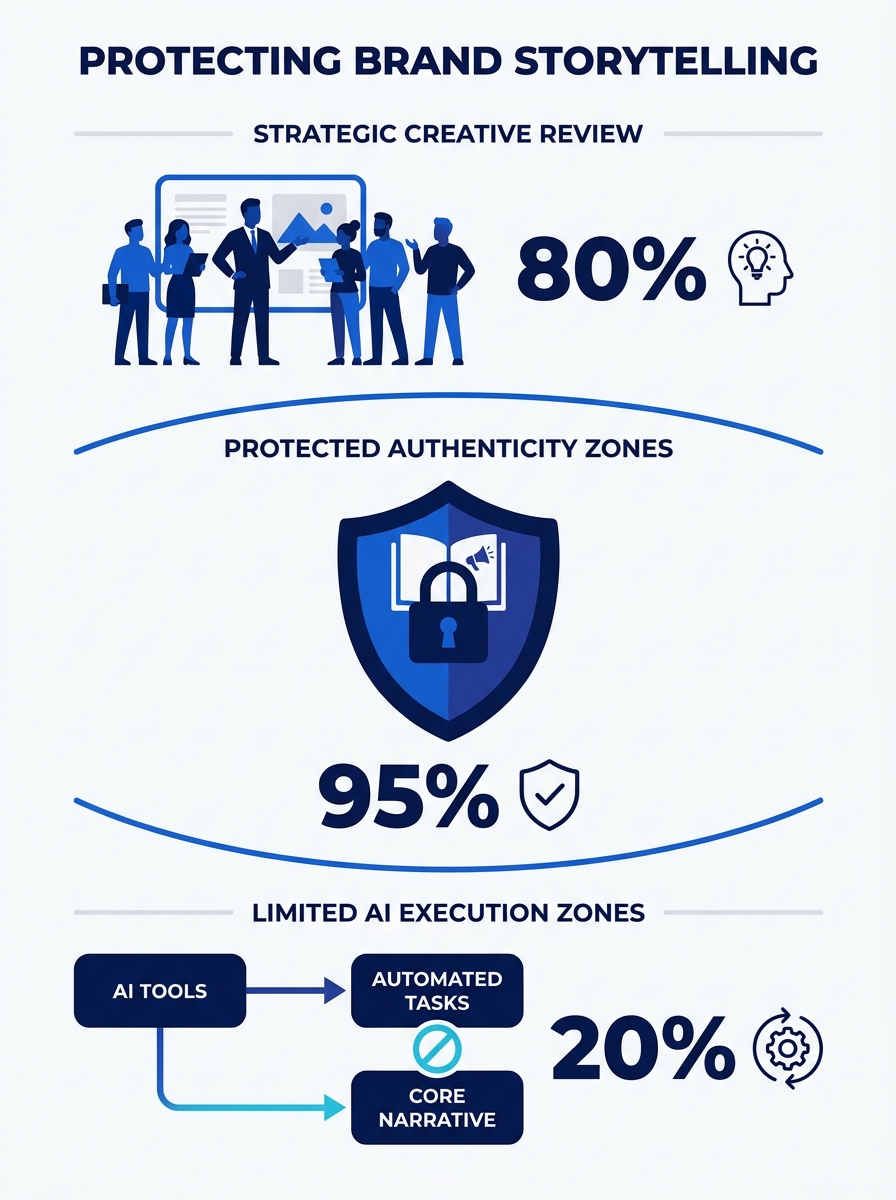
Five Strategic Areas Designated Off-Limits to Full Automation
The “human-only zones” framework identifies five marketing functions where CMOs should consciously resist full AI automation, according to the Wipro guidance. Strategic visioning, defining core brand story, values, and long-term positioning, heads the protected list. Emotional messaging and humor, which require nuanced human understanding to evoke specific feelings, comprise the second zone.
Creative direction, including artistic and aesthetic choices that establish distinctive visual and auditory brand identity, occupies the third protected area. Crisis communications demanding empathy, judgment, and sincere voice during sensitive situations cannot be delegated to algorithmic systems, the framework states.
Innovation and norm-challenging work rounds out the five zones. “AI, which primarily optimizes based on existing data, struggles to generate this kind of thinking independently,” Ghosh explained. Algorithmic content generation defaults toward pattern-matching rather than boundary-pushing ideas, the guidance warns.
The framework aligns with earlier marketing leader reports on brand differentiation requiring human creative oversight as AI content generation collapses asset value across categories.
Automation Trap Drives Homogenization Risk
Over-reliance on AI for content creation and distribution pushes brands into what the guidance terms “the automation trap”, algorithmic systems dictating messaging rather than serving as sophisticated production tools. When every business leans on the same large language models to craft communications, the result is indistinguishable content that strips away brand uniqueness, according to the framework.
Marketing becomes mechanical and predictable when efficiency optimization overrides distinctive voice, Ghosh wrote. UK businesses face particular risk that automated content renders brands entirely forgettable as consumers disengage upon detecting inauthenticity.
The homogenization threat extends beyond consumer perception. CMOs briefing agency partners on creative work must now specify which deliverables require full human execution versus hybrid AI-augmented workflows, the guidance suggests.
CMO Role Shifts Toward Creative Guardianship
Marketing leadership responsibilities are expanding beyond strategy and execution into active protection of human originality, the framework states. CMOs must champion environments where creativity thrives and drives competitive advantage rather than being optimized away by algorithmic systems.
That protective role demands investing in human talent, creating space for creative development, and valuing ideas that don’t fit algorithmic templates. “Humans must remain accountable for meaning, judgment, trust and the wider consequences of the stories they tell,” Ghosh stated.
The shift mirrors broader platform changes reshaping how marketing leaders should brief agency partners on search, creative, and social work as AI mediates more consumer touchpoints.
Proof-over-promise grounding in real customer experience and measurable impact should anchor storytelling work, the guidance recommends. Authenticity built on shared vision and human connection differentiates brands when AI-generated content commoditizes messaging across competitors.
Reading Between the Lines
The “human-only zones” framework hands marketing leaders briefing agency partners a clear negotiation structure: specify which deliverables require full human execution upfront, before scoping begins. That clarity matters when 51% of CMOs are deploying Generative AI tools and agencies are incentivized to maximize automation for margin protection. The five protected zones, strategic visioning, emotional messaging, creative direction, crisis work, innovation, aren’t anti-AI orthodoxy; they’re a working definition of where brand value creation still depends on human judgment.
The 70% consumer detection rate from Canva data explains why this matters commercially. Audiences disengage when they spot algorithmic shortcuts in creative work, which means over-automated content doesn’t just feel generic, it underperforms. For CMOs managing agency relationships, the implication is straightforward: AI augmentation can accelerate production timelines and scale distribution, but the core creative brief, the emotional resonance work, and the strategic positioning remain human accountability zones. Agencies that try to automate those deliverables produce forgettable output, regardless of how efficiently they ship it.