TK Business Magazine Publishes Generative Engine Optimization Framework as Industry Formalizes AI Search Practices

A framework for optimizing content for AI-powered search engines appeared in TK Business Magazine on July 30, 2026, formalizing practices that marketing teams have tested informally since ChatGPT and Google AI Overviews reshaped organic discovery twelve months earlier, according to the published guide. The framework synthesizes techniques including natural language processing integration, customer data platform linkage, and A/B testing protocols into a structured Generative Engine Optimization methodology.
TL;DR: TK Business Magazine published a GEO framework on July 30, 2026, consolidating AI search optimization practices as companies that deployed the techniques report organic traffic conversion gains, according to referenced Forrester and Search Engine Land analyses.
Industry Data Shows Early Adoption Results
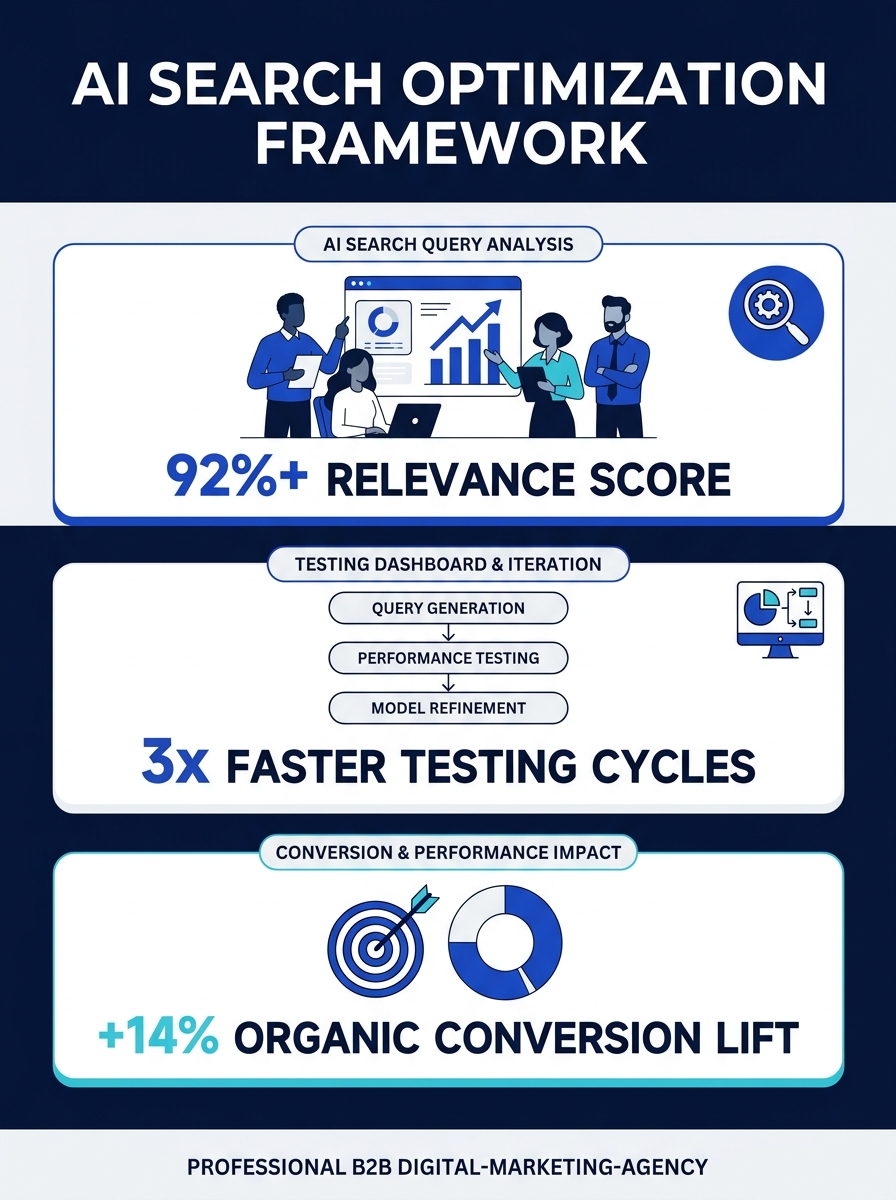
Companies implementing Generative Engine Optimization components reported measurable organic traffic conversion rate increases, according to a Forrester report cited in the framework. Search Engine Land analysis referenced in the guide showed businesses using A/B testing frameworks, multivariate testing, and attribution modeling alongside GEO techniques achieved improved SEO outcomes, though the publication did not disclose specific percentage uplifts or timeframes.
The framework positions GEO as an integration layer connecting natural language processing, machine learning models, and existing martech infrastructure including customer data platforms, programmatic advertising systems, and search engine marketing tools. Marketing leaders evaluating the methodology would brief agency partners to combine user intent prediction with personalized content strategies, the guide states.
Core Components Align with Enterprise Testing Protocols
The published framework centers on components familiar to enterprise marketing organizations already running conversion rate optimization programs. A/B testing frameworks and multivariate testing form the foundational layer, allowing teams to compare content variations, layout configurations, and call-to-action placements for traffic impact. Attribution modeling connects these tests to specific touchpoints driving conversions, while retargeting pixels and real-time bidding systems refine audience targeting precision.
User experience research and sentiment analysis tools provide measurement infrastructure for tracking how audiences interact with content optimized for generative engines, according to the framework. Marketing automation workflow systems enable continuous campaign monitoring and adjustment based on key performance indicators including bounce rates, session duration, and conversion metrics.
The guide recommends aligning GEO initiatives with omnichannel marketing strategies to maintain coherence across brand touchpoints. Demand-side platform investment appears as a recurring recommendation for enhancing precision and efficiency, though the framework does not specify vendor selection criteria or integration timelines.
Framework Publication Follows Measurement Gap Reports
The formalized GEO guide follows recent industry findings that only 38% of pages cited in Google AI Overviews come from traditional top-10 search results, creating visibility gaps that leave most marketing teams without infrastructure to track AI-mediated discovery. Marketing executives have reported mapping brand discovery shifts as AI agents increasingly mediate consumer decisions, pressuring organic teams to develop new optimization approaches.
The framework’s publication also arrives as practitioners debate whether existing enterprise SEO services adequately address AI search requirements or whether separate GEO programs require dedicated agency partnerships. Marketing leaders evaluating the methodology must determine whether to expand current SEO briefs, establish parallel GEO workstreams, or consolidate both under unified organic discovery objectives.
Organizations implementing the framework would need to integrate it with existing content authority strategies. Recent guidance on building brand authority for AI search and how large language models decide citation sources provides adjacent context for teams briefing agencies on GEO deployment. The framework does not address whether GEO practices conflict with or complement traditional ranking optimization.
Why This Matters Now
Philippine marketing leaders at enterprises and growth companies face a decision point: whether the formalization of GEO as a named discipline justifies separate budget allocation and agency partnerships, or whether the techniques fold into existing organic programs. The framework’s publication signals the practice has matured beyond informal experimentation, yet the absence of disclosed performance benchmarks or named case studies leaves evaluation teams without comparative data when briefing agencies or setting stakeholder expectations.
For CMOs overseeing APAC operations, the guide raises questions about regional platform variation. The framework references Western-centric tools including Google AI Overviews and ChatGPT search experiences, but does not address how the methodology translates to markets where Baidu, Naver, or regional LLM deployments shape organic discovery differently. Marketing directors evaluating whether to deploy GEO across multiple markets would need supplemental guidance on platform-specific optimization requirements.
The framework’s emphasis on existing martech integration—customer data platforms, attribution systems, A/B testing infrastructure—suggests GEO deployment would layer onto current enterprise stacks rather than require greenfield technology investment. That lowers activation barriers for organizations already running structured conversion rate optimization programs, but creates complexity for brands lacking mature testing cultures or unified customer data foundations. Marketing leaders must assess whether their organization possesses the infrastructure prerequisites before committing to full GEO implementation or whether staged rollouts aligned with broader martech consolidation make more strategic sense.