Traditional SEO alone won’t get you conversions anymore.
Even if you’ve got strong Google rankings, consumers could still miss out on your brand as they visit AI tools like ChatGPT for recommendations instead of visiting your website.
And the shift is already underway. By March 2026, 48% of Google queries reportedly triggered an AI Overview, and brands cited in those overviews saw 35% more organic clicks. (Truelogic, 2026)
That’s where Generative Engine Optimization (GEO) comes in. GEO is the process where your content, authority, and digital presence are optimized so your brand gets mentioned, recommended, and represented in AI Search results.
However, getting seen on AI search doesn’t prove you’ve got a working GEO strategy.
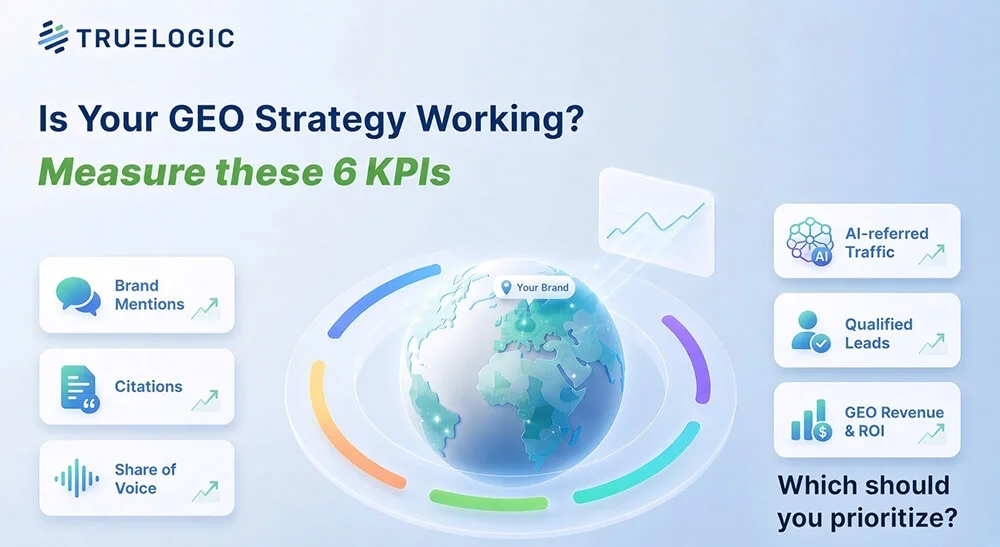
Check out these 6 essential GEO KPIs to track and how they drive success:
1. Brand Mentions
Brand mentions are the number of times AI tools name your company, products, or services when answering relevant questions. Frequent mentions mean you’re part of the conversation while buyers do their research.
This matters because 59% of global shoppers are more likely to shop from brands they consistently hear about. (Capital One Shopping, 2026)
2. Citations
A citation happens when an AI answer links to or names a source tied to your brand. A mention tells you the AI knows your name, and a citation tells you it pointed to a page of yours. Sometimes a brand gets named while a random third-party site gets the credit, and that’s a good hint something is missing.
Here’s the catch, though: more citations don’t automatically mean better results.
An AI answer can cite a page that paints your brand in a bad light, like an old complaint thread, a harsh review, or an article with outdated or wrong info about you. Citations also won’t always send clicks your way, since AI often answers the question right on the spot.
3. Share of Voice
Share of voice is the amount of AI answers that mention your brand compared to your competitors. For example, a hundred mentions sound great until you realize your competitor has 400. This KPI shows where you really stand in your industry.
Zalora grew 16x, Shopee 8x, and Ayalaland 75x in AI Overview gains, which shows how quickly the gap between brands can open (Truelogic, 2026). It’s worth slicing by topic as well, because a brand can look everywhere on broad subjects and still go missing on the services that pay the bills.
4. AI-Referred Traffic
AI-referred traffic is the number of website visits that come directly from AI platforms like ChatGPT. It’s a useful metric, but it only tells part of the story when it comes to measuring AI visibility.
Plenty of people discover a brand through an AI-generated answer, then head back to Google to learn more or visit the website directly later on. When that happens, analytics platforms typically credit the last click, not the AI tool that introduced the brand in the first place.
That’s important to keep in mind because AI-referred visitors are often higher-intent users. In fact, our reports suggest they convert 4.4x better than traditional organic visitors, meaning even a relatively small amount of AI-referred traffic can have a significant business impact. (Truelogic, 2026).
5. Qualified Leads
Qualified leads are prospects who match your ideal customer profile and demonstrate genuine interest in what you offer.
An increase in these high-intent prospects can signal that your brand is appearing in AI-generated responses that align with real user needs and purchase intent.
In fact, companies that excel at lead nurturing generate 50% more sales-ready leads while reducing acquisition costs by 33%!
6. GEO Revenue and ROI
GEO revenue is the income generated from consumers whose buying journey included an AI touchpoint, while ROI measures whether that revenue justifies your investment.
Use Google Analytics 4 (GA4) to track website visits from AI platforms and monitor conversions, such as purchases or inquiries. Compare these results with your GEO spending and sales records to understand whether your efforts are contributing to business growth.
However, not every consumer who finds your brand through AI will visit your website directly from an AI platform.
Some may return through Google or visit your website later. Track these indirect journeys where possible, and remember that other marketing campaigns and seasonal changes may also influence sales.
Which GEO KPI Should You Prioritize?
Depends on what your brand wants to accomplish.
|
Your Goal |
Lead KPI |
|---|---|
|
Get known |
Brand mentions |
|
Build trust |
Citations |
|
Beat competitors |
Share of voice |
|
Bring in visitors |
AI-referred traffic |
|
Create demand |
Qualified leads |
|
Prove it pays |
Revenue and ROI |
If you’re early in your GEO journey, prioritize brand mentions, citations, and share of voice to establish a baseline before measuring pipeline impact.
See the Full Picture
Every GEO number tells you something, but not one tells you everything.
Since AI answers vary by prompt, platform, and time, consistent tracking matters more than any single snapshot. Looking at these KPIs together gives you a clearer picture of your brand’s AI visibility and whether it’s translating into growth.
Build your GEO strategy with Truelogic today.