4Ps of Marketing: Framework Guide for Philippine Businesses
Why the 4Ps Still Matter for Philippine Businesses
Marketing frameworks come and go. Some get rebranded every few years with flashy new terminology. But the 4Ps of marketing — Product, Price, Place, and Promotion — have stuck around since the 1960s for a reason: they work. And they work especially well when you adapt them to a specific market context.
For Philippine businesses, whether you’re a sari-sari store owner scaling into e-commerce or a mid-size company trying to compete with multinationals, the 4Ps give you a structured way to think about your go-to-market strategy. Not in some abstract, textbook way. In a practical, “here’s what to do on Monday morning” way.
The Philippines has one of the most dynamic consumer markets in Southeast Asia. Digital landscape shifts in 2026 are reshaping how Filipino consumers discover, evaluate, and purchase products. Social commerce is booming. Mobile-first behavior isn’t a trend anymore — it’s the default. And all of this means your marketing mix needs to be sharper than ever.
This guide breaks down the 4Ps framework specifically for Philippine businesses, with actionable steps, common pitfalls, and the tools you need to execute well.
The 4Ps of Marketing: A Quick Refresher
Before we get into the Philippine-specific applications, let’s make sure we’re on the same page about what the 4Ps actually are.
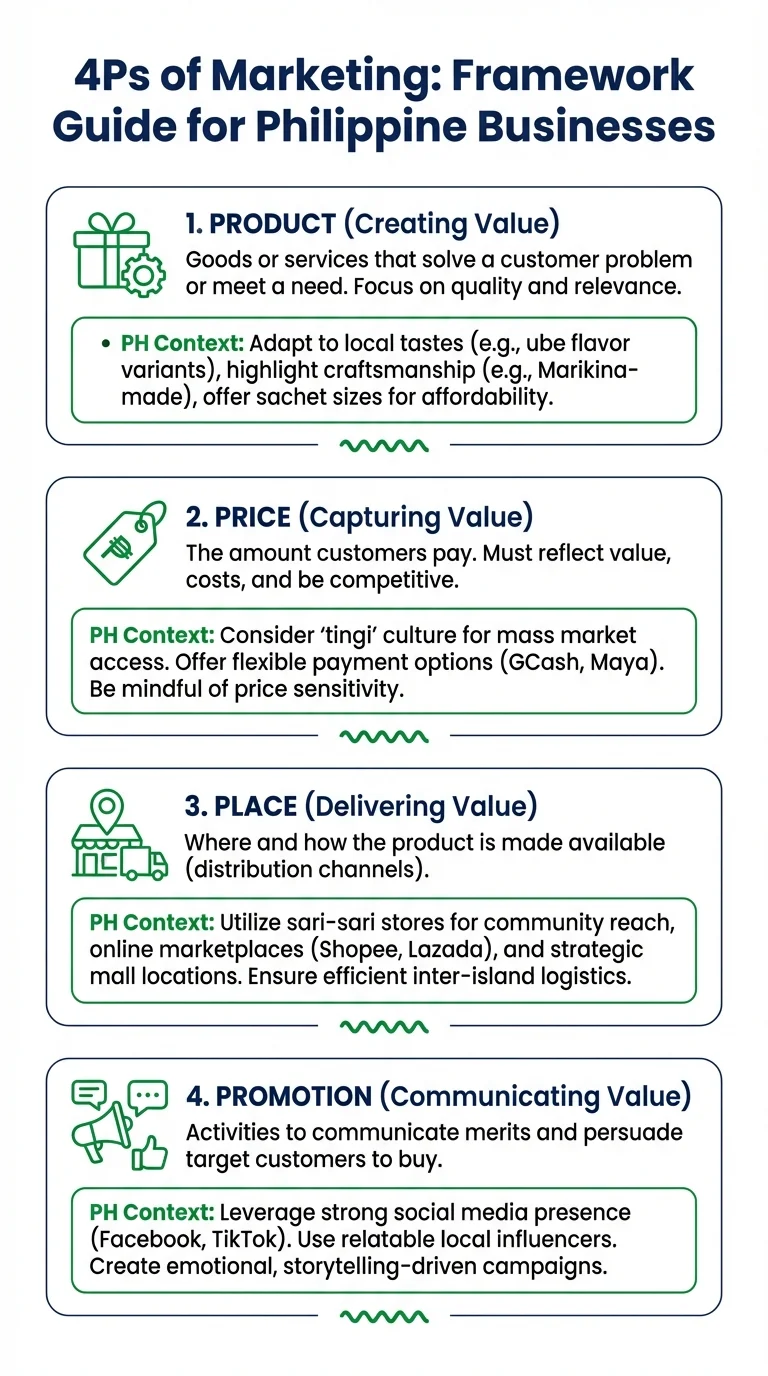
Product
This is what you sell. But it’s more than just the physical item or service. Product encompasses your features, quality, branding, packaging, and the problem you’re solving for your customer. It also includes your product line depth — are you offering one hero SKU or a full range?
Price
What your customer pays. Pricing strategy goes far beyond slapping a number on a tag. It includes discounts, payment terms, perceived value, and how you position yourself against competitors. In the Philippines, where price sensitivity varies wildly between Metro Manila and provincial markets, this P deserves serious attention.
Place
Where and how your product reaches the customer. Distribution channels, retail locations, online marketplaces, logistics partners — all of it falls under Place. For Philippine businesses, this often means juggling physical stores, Shopee/Lazada presence, social media selling, and maybe even a D2C website.
Promotion
How you communicate your product’s value to your target market. Advertising, PR, content marketing, influencer partnerships, SEO, paid search — these are all promotional tactics. The key is matching your promotional mix to where your audience actually spends their time.
Research on 4Ps among OTOP entrepreneurs in the Philippines found that all four elements significantly impact sales performance. That’s not surprising. What’s useful is understanding that neglecting even one P creates a bottleneck that drags down the others.
Applying the 4Ps Framework: A Step-by-Step Approach for Philippine Businesses
Theory is nice. Execution is better. Here’s how to work through each P with your Philippine market in mind.
Step 1: Define Your Product for the Filipino Consumer
Start with the problem you’re solving. Filipino consumers are value-conscious but not purely price-driven. They care about quality, brand trust, and increasingly, sustainability. Your product positioning should reflect this.
Ask yourself:
- What specific pain point does my product address for Filipino customers?
- How does my product differ from what’s already available on Shopee, Lazada, or in SM malls?
- Is my packaging appropriate for the Philippine market? (Sachet economy is real — smaller, affordable packaging often outperforms bulk options.)
- Does my product need localization? Think flavors, sizes, language on packaging, or even cultural relevance.
A common mistake here is assuming what works in other markets will automatically translate. It won’t. Jollibee didn’t beat McDonald’s in the Philippines by copying the American playbook. They understood the Filipino palate and built a product line around it.
Step 2: Set Your Pricing Strategy
Pricing in the Philippines requires nuance. The market spans from ultra-budget-conscious consumers to a growing affluent middle class willing to pay premium prices for perceived quality.
Consider these pricing approaches:
- Penetration pricing: Enter the market with lower prices to build volume and brand awareness. Works well for new FMCG brands competing against established players.
- Value-based pricing: Price based on perceived value rather than cost-plus. This works for service businesses, tech products, and premium brands.
- Tiered pricing: Offer good-better-best options. This is particularly effective in the Philippine market where income levels vary dramatically across regions.
- Installment/payment plans: Filipinos love installment options. If you can offer “0% interest for 6 months” or integrate with GCash/Maya payment plans, you remove a major purchase barrier.
Don’t forget to factor in marketplace fees. If you’re selling on Shopee or Lazada, their commission structures eat into your margins. Price accordingly.
Step 3: Optimize Your Distribution (Place)
The Philippines is an archipelago of over 7,600 islands. That geographic reality makes distribution one of the most challenging — and most important — Ps to get right.
Your Place strategy should consider:
- Online marketplaces: Shopee and Lazada dominate, but TikTok Shop is growing fast. Having a presence on at least one major platform is practically non-negotiable for consumer brands.
- Social commerce: Many Filipino businesses generate significant revenue through Facebook Marketplace, Instagram DMs, and Viber groups. Don’t underestimate this channel.
- Physical retail: For certain product categories, presence in SM, Robinsons, or local convenience stores still matters enormously.
- Direct-to-consumer (D2C) websites: Building your own e-commerce site gives you more control over the customer experience and better margins. But it requires investment in search engine optimization to drive organic traffic.
- Logistics partners: J&T, LBC, Ninja Van, and Grab Express are popular last-mile delivery options. Your choice of logistics partner directly impacts customer satisfaction.
The smartest Philippine businesses don’t pick just one channel. They build an omnichannel presence and meet customers wherever they prefer to shop.
Step 4: Build Your Promotional Mix
This is where most businesses want to start. Resist that urge. Promotion works best when the other three Ps are already solid. You can run the best ad campaign in the world, but if your product is mediocre, your pricing is off, or your distribution is unreliable, you’re burning money.
That said, promotion is where Philippine businesses have tremendous opportunity right now. Digital marketing for Filipino businesses has matured significantly, and the tools available today are more accessible than ever.
Key promotional channels for Philippine businesses:
- SEO and content marketing: Long-term play, but incredibly valuable. Filipino consumers search Google before making purchase decisions, especially for services and higher-ticket items. Investing in AI-powered SEO services can help you capture that demand more efficiently.
- Paid search (PPC): Google Ads and PPC campaigns let you show up at the top of search results immediately. This is particularly effective for service businesses and e-commerce brands with healthy margins.
- Social media marketing: Filipinos are among the most active social media users globally. Facebook remains dominant, but TikTok, Instagram, and YouTube are all critical channels depending on your demographic.
- Influencer marketing: Micro-influencers (10K–100K followers) often deliver better ROI than celebrity endorsements in the Philippine market. Authenticity matters more than reach.
- Email and messaging: Don’t sleep on email marketing and Viber/Messenger campaigns. They’re low-cost and high-conversion for repeat customers.
And here’s something many businesses overlook: link building is a promotional activity too. Earning mentions and backlinks from reputable Philippine publications and industry sites builds both your domain authority and your brand credibility simultaneously.
Common Mistakes Philippine Businesses Make with the 4Ps
I’ve seen these errors repeatedly. Avoid them.
1. Treating the 4Ps as a One-Time Exercise
Your marketing mix isn’t something you set once and forget. Markets shift. Competitors enter. Consumer preferences evolve. Review your 4Ps quarterly at minimum.
2. Copying Multinational Strategies Without Localization
What works for Unilever globally doesn’t automatically work for a local brand in Cebu or Davao. Localize everything — from product sizing to promotional messaging to distribution channels.
3. Underpricing to Compete
Racing to the bottom on price is a losing strategy for most small and medium businesses. You can’t outspend the big players on volume. Instead, compete on value, service quality, or niche specialization.
4. Ignoring Digital Distribution
Some traditional businesses still resist selling online. That’s leaving money on the table. Even if your primary revenue comes from physical stores, an online presence extends your reach and provides valuable customer data.
5. Over-Investing in Promotion Without Fixing Fundamentals
Pouring budget into Facebook ads when your product has a 2-star rating on Shopee? That’s not a promotion problem. That’s a product problem. Fix the fundamentals first.
6. Neglecting Post-Purchase Experience
The 4Ps traditionally focus on getting the sale. But in the Philippine market, where word-of-mouth and social proof carry enormous weight, your post-purchase experience — packaging, delivery speed, customer service — is effectively a fifth P. Ignore it at your peril.
4Ps Best Practices Checklist for Philippine Businesses
Use this as a quick reference when reviewing your marketing mix:
Product:
- ☐ Clear unique selling proposition (USP) defined
- ☐ Product tested with actual Filipino consumers (not just internal team feedback)
- ☐ Packaging appropriate for target market segment
- ☐ Product line includes accessible entry-level options
- ☐ Quality consistent across batches/deliveries
Price:
- ☐ Competitive analysis completed for your category
- ☐ Pricing accounts for marketplace fees and logistics costs
- ☐ Payment options include digital wallets (GCash, Maya)
- ☐ Installment or bundle options available where appropriate
- ☐ Promotional pricing calendar planned (11.11, 12.12, payday sales)
Place:
- ☐ Present on at least one major online marketplace
- ☐ Social commerce channels active and monitored
- ☐ Logistics partners vetted for reliability in target regions
- ☐ D2C website optimized for mobile and search
- ☐ Inventory management system in place to prevent stockouts
Promotion:
- ☐ SEO strategy in place for organic visibility
- ☐ Paid advertising budget allocated with clear ROAS targets
- ☐ Social media content calendar maintained
- ☐ Customer reviews and testimonials actively collected
- ☐ Analytics tracking set up to measure promotional effectiveness
Tools and Resources to Execute Your 4Ps Strategy
You don’t need enterprise-level software to implement a solid marketing mix. Here are practical tools accessible to Philippine businesses of all sizes:
For Product Research
- Google Trends (Philippines): Free tool to spot rising product interest and seasonal demand patterns.
- Shopee/Lazada Seller Center analytics: If you’re already selling on these platforms, their built-in analytics show you what’s trending and how your products compare.
- SurveyMonkey or Google Forms: Quick, cheap way to gather customer feedback on product features and preferences.
For Pricing
- Competitor price monitoring tools: Prisync or manual tracking spreadsheets work for smaller operations.
- Marketplace repricing tools: Shopee and Lazada offer built-in pricing tools for sellers.
For Place/Distribution
- Shopify or WooCommerce: For building your own D2C store with Philippine payment gateway integrations.
- GCash/Maya merchant accounts: Essential for accepting digital payments.
- Shipment tracking integrations: Most major Philippine logistics providers offer API integrations or seller dashboards.
For Promotion
- Google Search Console and Google Analytics: Free, essential for understanding your organic search performance.
- Meta Business Suite: Manage Facebook and Instagram advertising from one dashboard.
- Canva: Create professional-looking promotional materials without a graphic designer.
- Ahrefs or SEMrush: For deeper SEO and competitive analysis. Worth the investment if you’re serious about organic growth.
Frequently Asked Questions
Are the 4Ps of marketing still relevant for digital businesses?
Absolutely. The 4Ps aren’t limited to physical products and brick-and-mortar stores. For digital businesses, “Product” might be a SaaS tool or online course, “Place” is your website and app stores, and “Promotion” leans heavily on digital channels. The framework is flexible enough to apply to virtually any business model.
How do the 4Ps differ for B2B vs. B2C businesses in the Philippines?
B2B businesses typically have longer sales cycles, higher price points, and more emphasis on relationship-building. The “Place” P often shifts toward direct sales teams, LinkedIn, and industry events rather than marketplaces. Promotion focuses more on thought leadership, case studies, and targeted outreach rather than mass-market advertising.
Should I prioritize one P over the others?
No. That’s the whole point of the framework — the four Ps work together as a system. A weakness in any one area undermines the others. That said, if you’re just starting out, get your Product right first. Everything else builds on that foundation.
How often should I revisit my 4Ps strategy?
At minimum, do a thorough review every quarter. But you should be monitoring key metrics continuously. If you notice a sudden drop in sales, a new competitor entering your space, or shifting consumer behavior, that’s your signal to reassess.
What’s the biggest 4Ps mistake for Philippine startups?
Spending too much on Promotion before validating Product-market fit. I’ve seen startups burn through their entire seed funding on ads for a product nobody actually wants. Validate first, then scale your promotional spend.
Putting It All Together
The 4Ps framework isn’t glamorous. It’s not the newest marketing concept. But it remains one of the most effective tools for building a coherent marketing strategy — especially for Philippine businesses operating in a market that’s rapidly digitizing while still deeply rooted in traditional commerce.
The businesses that win aren’t the ones with the biggest budgets. They’re the ones who think systematically about their product, price it intelligently, distribute it where their customers actually are, and promote it through the right channels with the right message.
And here’s the thing: you don’t have to figure all of this out alone. If you’re looking to strengthen the Promotion side of your 4Ps — particularly your organic search visibility and digital marketing performance — talk to the Truelogic team about SEO. We’ve helped hundreds of Philippine businesses turn their online presence into a genuine growth engine. Let’s build yours.