SEO for Startups: From Traffic to Revenue

For startups, SEO represents one of the most cost-effective marketing channels available. Unlike paid advertising that stops delivering the moment you stop paying, SEO investments compound over time, building sustainable traffic that grows alongside your business.
But startup SEO requires a different approach than established business SEO. With limited resources, smaller teams, and the need for rapid growth, startups must be strategic about where they focus their efforts.
Why SEO Matters for Startups

According to BrightEdge research, organic search drives 53% of all website traffic. For startups operating on tight budgets, capturing this traffic without ongoing ad spend creates sustainable competitive advantage.
The startup SEO advantage:
- Cost efficiency: SEO costs are primarily upfront, with ongoing benefits
- Compound growth: Rankings and traffic build over time
- Credibility: Organic rankings signal trustworthiness to customers
- Market intelligence: Keyword research reveals customer needs
- Competitive moats: Strong SEO creates barriers for later entrants
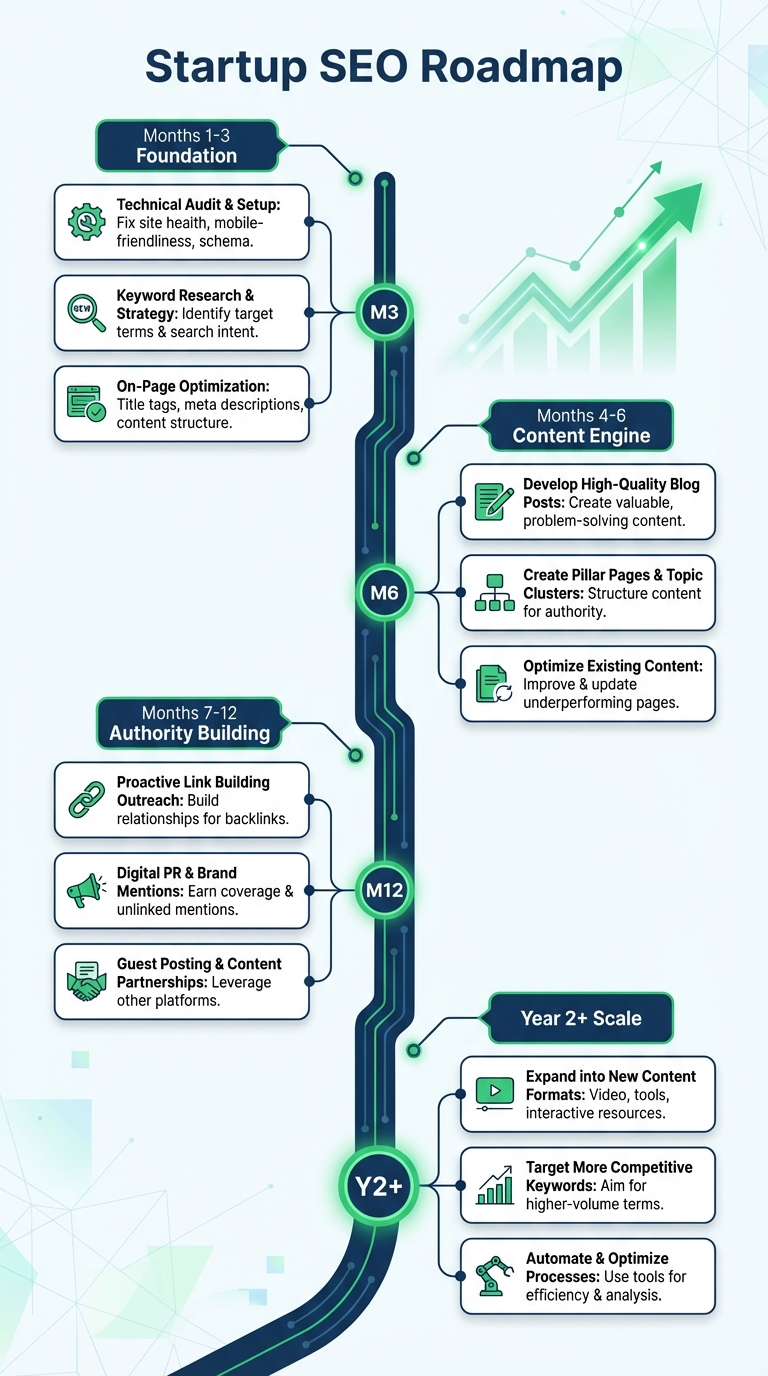
The Startup SEO Roadmap
Phase 1: Foundation (Months 1-3)
Before pursuing rankings, establish your SEO foundation:
- Technical SEO basics: Ensure your site is crawlable, fast, and mobile-friendly
- Keyword research: Identify terms your target customers actually search
- Site structure: Organize content logically for users and search engines
- Analytics setup: Implement tracking to measure progress
- Google Business Profile: Claim and optimize for local visibility
Phase 2: Content Engine (Months 4-6)
Build your content marketing engine:
- Core pages: Optimize homepage and key service/product pages
- Blog launch: Start publishing valuable content targeting key terms
- Content calendar: Plan consistent publishing cadence
- Topic clusters: Organize content around core themes
Plan your content strategy with our content calendar guide.
Phase 3: Authority Building (Months 7-12)
Build credibility with link building:
- Guest posting: Contribute to industry publications
- Digital PR: Create newsworthy stories and data
- Partnership links: Leverage business relationships
- Resource creation: Build linkable tools and guides
Phase 4: Scale (Year 2+)
With foundation established, scale efforts:
- Expand keyword targeting
- Increase content production
- Build link acquisition velocity
- Explore new content formats
- Consider international markets
Startup SEO on a Budget
Limited resources require prioritization. Focus on:
High-Impact, Low-Cost Activities
- Keyword research: Free tools like Google Keyword Planner, AnswerThePublic
- On-page optimization: Optimizing existing content costs only time
- Technical fixes: Many improvements require development time, not money
- Google Business Profile: Free but high-impact for local visibility
DIY vs. Agency
Startups often ask whether to handle SEO in-house or hire an agency. Consider:
- In-house advantages: Lower cost, faster iteration, deep product knowledge
- Agency advantages: Expertise, tools, bandwidth, proven processes
Many startups start in-house, then engage an SEO agency as they scale and need specialized expertise.
Keyword Strategy for Startups
Startups can’t compete immediately for high-volume, competitive terms. Instead:
Target Long-Tail Keywords
Long-tail keywords have lower volume but higher conversion rates and less competition. For a fintech startup:
- Competitive: “personal finance app”
- Long-tail: “budgeting app for Filipino freelancers”
The long-tail version reaches a more targeted audience with less competition.
Find Keyword Gaps
Use competitor analysis to find terms competitors haven’t fully covered. These gaps represent opportunities to establish authority before competition arrives.
Match Search Intent
Understand what searchers want:
- Informational: “How does [solution] work?”
- Commercial: “Best [solution] for [use case]”
- Transactional: “[Solution] pricing”
Create content matching each intent along the customer journey.
Technical SEO Essentials for Startups
Get the basics right before focusing on advanced tactics:
Site Speed
Slow sites lose visitors and rankings. Prioritize:
- Image compression and optimization
- Minimal third-party scripts
- Quality hosting infrastructure
- CDN for global visitors
Mobile-First
Google uses mobile-first indexing. Ensure:
- Responsive design on all pages
- Touch-friendly navigation
- Readable text without zooming
- Fast mobile load times
Core Web Vitals
Meet Google’s page experience standards:
- LCP: Under 2.5 seconds
- INP: Under 200ms
- CLS: Under 0.1
Learn more in our UX metrics guide.
Content Strategy for Startup Growth
Content is how startups build SEO momentum. Focus on:
Product-Led Content
Create content that naturally features your product solving real problems:
- How-to guides using your product
- Problem-solution content targeting pain points
- Comparison content positioning against alternatives
- Use cases for different customer segments
Thought Leadership
Establish founder and team expertise:
- Industry insights and analysis
- Original research and data
- Trend predictions and commentary
- Expert interviews and roundups
Community Content
Build audience engagement:
- Customer success stories
- User-generated content
- Community resources and guides
- Event recaps and coverage
Link Building for Startups
Startups can punch above their weight with creative link building:
Leverage the Startup Story
Media outlets cover interesting startup journeys:
- Funding announcements
- Product launches
- Milestone achievements
- Founder stories
Create Shareable Assets
Invest in content that attracts links:
- Original research and surveys
- Free tools and calculators
- Industry reports
- Visual content and infographics
Build Relationships
Network within your industry:
- Industry events and conferences
- Online communities and forums
- Podcast appearances
- Collaborative content
Measuring Startup SEO Success
Track metrics that matter for startup growth:
- Organic traffic growth: Month-over-month and year-over-year
- Keyword rankings: Movement for target terms
- Conversions: Sign-ups, trials, or purchases from organic
- Revenue attribution: Business value from SEO
- Domain authority: Overall site strength growth
Dive deeper in our essential KPIs guide.
Common Startup SEO Mistakes
Avoid these common pitfalls:
- Targeting too broadly: Chasing high-volume terms before building authority
- Neglecting technical basics: Broken foundations undermine all other efforts
- Inconsistent effort: SEO requires sustained investment, not sporadic attention
- Ignoring user intent: Creating content that doesn’t match what searchers want
- Expecting immediate results: SEO takes months to show significant returns
AI-Powered SEO for Startups
AI tools help startups do more with less:
- Content creation assistance: Speed up research and drafting
- Keyword research: Identify opportunities faster
- Technical audits: Automated issue detection
- Competitor analysis: Quick insights at scale
Explore AI-powered SEO services designed for growing businesses.
Working with an SEO Partner
The right SEO partner accelerates startup growth by providing expertise your team doesn’t have time to develop in-house.
Truelogic helps Philippine startups build sustainable organic growth through strategic SEO. Contact us to discuss how we can support your startup’s growth journey.
Building SEO into Your Startup Culture
The most successful startup SEO programs integrate search optimization into the company’s DNA rather than treating it as an afterthought:
SEO in Product Development
Consider SEO implications during product decisions:
- Feature naming that matches how customers search
- URL structure designed for SEO from the start
- Content management systems that support optimization
- Technical architecture that enables search crawling
Cross-Functional SEO Awareness
Everyone impacts SEO—train your team:
- Content creators understand keyword targeting
- Developers consider technical SEO in code
- Product managers factor search visibility into decisions
- Customer success teams identify content opportunities from support queries
Data-Driven Decision Making
Build SEO data into your analytics culture:
- Track organic traffic alongside other channels
- Report SEO metrics in company dashboards
- Set SEO goals alongside revenue targets
- Celebrate SEO wins as team achievements
Startup SEO Timeline: What to Expect
Set realistic expectations for your SEO investment:
Months 1-3: Foundation
- Technical issues fixed
- Initial keyword research complete
- First content pieces published
- Baseline metrics established
Months 4-6: Early Traction
- Long-tail rankings beginning
- Organic traffic starting to grow
- Content library building
- First links acquired
Months 7-12: Growth
- Meaningful traffic increases
- Rankings for more competitive terms
- Conversions from organic search
- Authority metrics improving
Year 2+: Scale
- Organic as major acquisition channel
- Rankings for high-value terms
- Strong domain authority
- Compound growth effects visible
SEO is a marathon, not a sprint. The startups that succeed are those willing to invest consistently over time rather than expecting overnight results.
Startup SEO Resources
Free resources to accelerate your SEO education:
- Google Search Central: Official documentation and best practices
- Ahrefs Blog: Actionable tutorials and case studies
- Moz Beginner’s Guide: Comprehensive SEO fundamentals
- Search Engine Journal: Industry news and updates
When to Invest More in SEO
Signs it’s time to increase SEO investment:
- Early SEO efforts showing positive ROI
- Product-market fit validated and scaling needed
- Competitors gaining ground in search
- Paid acquisition costs rising unsustainably
- Leadership buy-in for long-term organic strategy
The best time to double down on SEO is before you need to—building organic presence takes time, so proactive investment pays dividends when you need growth most.
Philippine Startup SEO Considerations
Local factors for Philippine startups:
- Local search: Optimize for “near me” and location-based queries
- Language: Consider Filipino/English content mix for your audience
- Mobile-first: High mobile usage in Philippine market
- Local SEO: Google Business Profile essential for local visibility
- Regional targeting: Metro Manila vs provincial market considerations
The Philippine startup ecosystem continues to grow, creating both opportunities and competition in organic search. Early SEO investment establishes positions that become harder for competitors to challenge as your authority builds.
From Traffic to Revenue: The Startup SEO Conversion Path
Traffic alone doesn’t grow startups—conversions do. Optimize your organic traffic path:
Conversion-Focused Landing Pages
Ensure pages ranking for key terms are optimized to convert:
- Clear value propositions above the fold
- Compelling calls-to-action matching search intent
- Social proof and credibility indicators
- Friction-free signup or purchase flows
- Fast load times and mobile optimization
Content to Conversion Mapping
Align content with conversion goals:
- Top-funnel content: Build awareness, capture email addresses
- Mid-funnel content: Educate, nurture interest, drive trials
- Bottom-funnel content: Convert ready buyers with product-focused pages
Attribution and Measurement
Track the full journey from organic search to revenue:
- Multi-touch attribution for longer sales cycles
- Assisted conversion tracking
- Cohort analysis for content engagement
- Customer lifetime value from organic channels
When you can demonstrate clear ROI from SEO investments, securing continued resources becomes significantly easier—and your startup benefits from the compound effects of sustained organic growth.