The Hidden SEO Tax: Why Enterprise Site Architecture Breakdowns Cost You 40% of Organic Revenue

Forbes’ organic search visibility fell by an estimated 60–80% over 2024–2025, concentrated in its diversified subdirectory structure and affiliate content arm, Forbes Advisor. The decline is the clearest public case study of how enterprise site architecture SEO debt compounds into an organic traffic conversion gap that no amount of content production can close.
Forbes Advisor and the Subdirectory That Swallowed the Domain
Forbes built Forbes Advisor as a subdirectory under its main domain (forbes.com/advisor/) to capture high-value commercial queries: credit cards, insurance, banking products. The strategy worked for a while. Forbes Advisor pages inherited the editorial trust signals of Forbes’ journalism, ranking aggressively for queries with strong commercial intent.
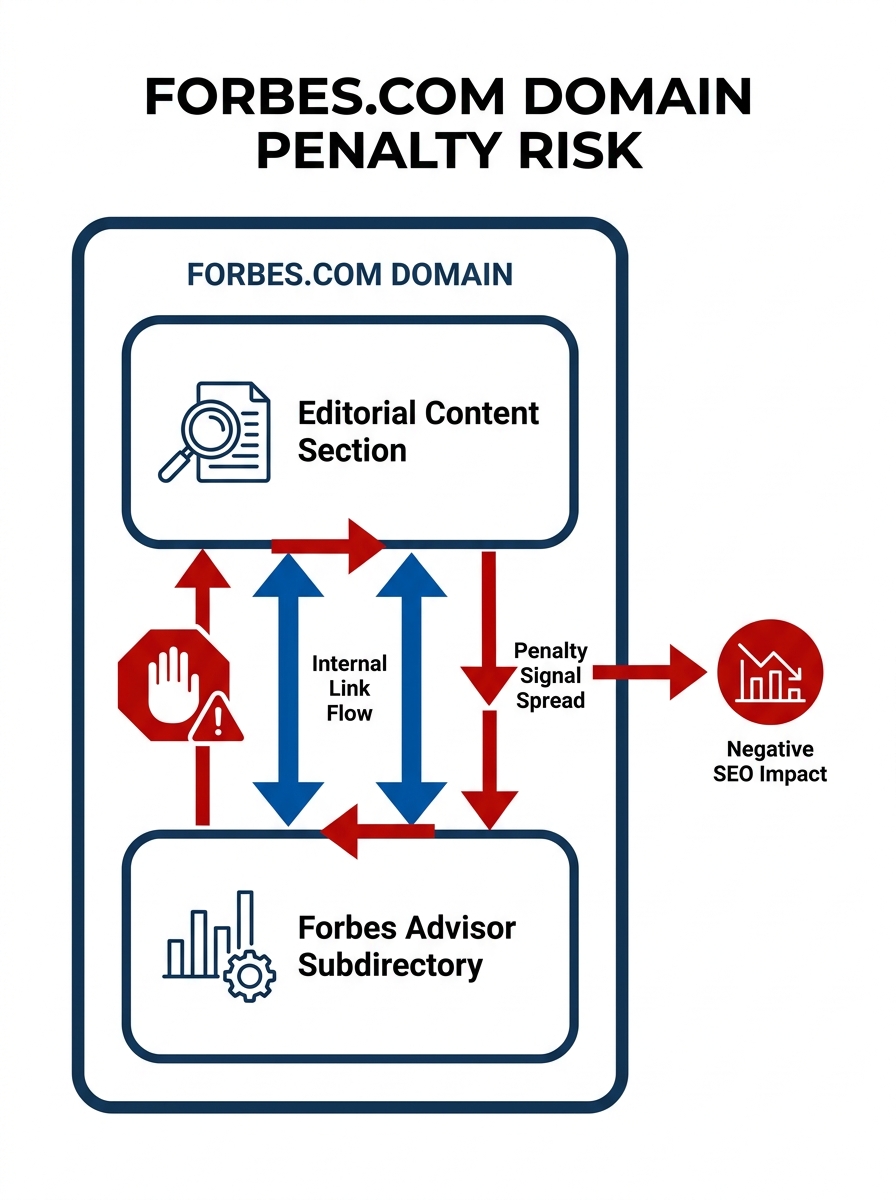
The architecture problem was structural from the start. Forbes was housing two fundamentally different content businesses under one domain: editorial journalism and affiliate-driven product comparison content. The internal linking structure wove these together, meaning Forbes’ news articles linked into Advisor pages, and Advisor pages linked back into news content. Google’s crawlers saw one domain with one authority profile. But the content served two different user intents, and those intents increasingly conflicted.
When Google’s algorithm updates and manual actions targeted the affiliate content for quality problems, the damage didn’t stay contained to Forbes Advisor. It spread across the domain. A Passionfruit SEO analysis documented the estimated 60–80% decline in organic search visibility, noting that unlike HubSpot’s broader traffic losses during the same period, Forbes’ decline was “largely concentrated in its diversified content structure, particularly affecting its affiliate marketing arm.”
Forbes didn’t lose rankings because its journalism deteriorated. It lost rankings because its site architecture made it impossible for Google to evaluate the affiliate arm independently from the editorial one. That’s the architecture tax: a structural coupling that turns one division’s content quality problem into a domain-wide organic revenue crisis.
The Crawl Budget Arithmetic That Broke First
For a site with millions of indexed URLs, the technical breakdown starts with crawl budget. Enterprise sites operate under a finite crawl allocation from Google, the number of pages Googlebot will fetch and process on any given crawl cycle. When architecture problems multiply the number of URLs without adding proportional value, the math turns destructive.
Forbes’ architecture created several compounding problems. Redirect chains (A → B → C paths) between old URLs, migrated pages, and current content added latency to each crawl request and wasted budget on intermediate hops. The 2026 internal link audit framework from Incremys identifies redirect chains as a primary crawl dilution risk, noting they “add latency and complicate crawling, with a risk of dilution and wasted crawl.” Generic anchor text like “click here” and “learn more” further degraded the semantic signal that internal links are supposed to carry, turning what should be an internal linking strategy into noise.
At enterprise scale, these problems compound through template inheritance. A single template change that introduces a 0.1% error rate across a site with millions of URLs produces thousands of broken pages overnight. The SEO implementation bottleneck here isn’t knowledge. Teams know what’s broken. The bottleneck is that fixing one template propagates changes across hundreds of thousands of pages, and the risk calculus paralyzes decision-making.
The information architecture audit Forbes needed wasn’t a list of broken links. It was a structural accounting of how crawl budget was being allocated across content types, which subdirectories were consuming disproportionate crawl attention relative to their revenue contribution, and where redirect chains were silently eating into the crawlable surface area of high-value pages. Technical SEO optimization remains the backbone of enterprise SEO strategy because, as Blacksmith Agency’s enterprise framework notes, “search engines can’t access your website’s pages when crawlability problems exist. These pages become invisible in search results.”
For enterprise brands evaluating their own architecture, the parallel is direct. We’ve written about how site architecture maps to organic growth compounding, and the Forbes case validates the principle from the negative direction: architecture that dilutes signals doesn’t slow growth gradually. It creates conditions for sudden, cascading collapse.
An Org Chart Where SEO Had No Authority
The technical failures at Forbes were visible in retrospect. But the reason they persisted and compounded was organizational, not technical.
A Search Engine Journal analysis of the hidden organizational forces that undermine enterprise SEO identified a pattern that maps precisely onto what happened at Forbes: “The SEO team lacks authority. Other teams lack incentive. Decisions are slow and political. Execution is trapped in a legacy process.” This description isn’t unique to Forbes. It describes the default operating condition at most enterprises with 500+ person marketing organizations.
Enterprise SEO operates in an environment where the people who understand site architecture rarely control the CMS, the deployment calendar, or the subdirectory strategy. At Forbes, the Advisor team operated with its own commercial incentives: affiliate revenue, product partnerships, volume-driven content production. The editorial side operated with entirely different KPIs. The SEO function sat between them, with visibility into the architectural damage but without organizational authority to force structural changes.
Research on enterprise SEO governance from Belov Digital recommends establishing cross-functional SEO councils with clear KPIs, implementing single sign-on for tools to bypass IT bottlenecks, and using collaborative platforms integrated with SEO alerts for real-time alignment. The recommendations sound straightforward. In practice, they mean giving the SEO function veto power over subdirectory creation, content type proliferation, and template changes, which is authority that product teams and revenue teams resist because it adds friction to their own workflows.
Organizations that implement only 15% of SEO recommendations due to stakeholder misalignment aren’t failing because the recommendations are wrong. They’re failing because the internal linking strategy, the information architecture audit, and the technical fixes all require cooperation from teams whose performance metrics don’t include organic search health. The enterprise SEO audit backlog problem we’ve documented shows organizations carrying 1,400+ open SEO tickets, each one a known architectural issue deprioritized against competing development demands.
Organizations that implement only 15% of SEO recommendations aren’t failing because the recommendations are wrong. They’re failing because every fix requires cooperation from teams whose metrics don’t include organic search health.
This is where an in-house SEO upskilling program becomes a structural investment rather than a training expense. When product managers and developers understand why a subdirectory decision carries architectural consequences, they push back less on SEO governance. But training alone won’t solve the authority gap. That requires executive sponsorship and KPI alignment across divisions.
The Revenue Signal That Arrived Six Months Late
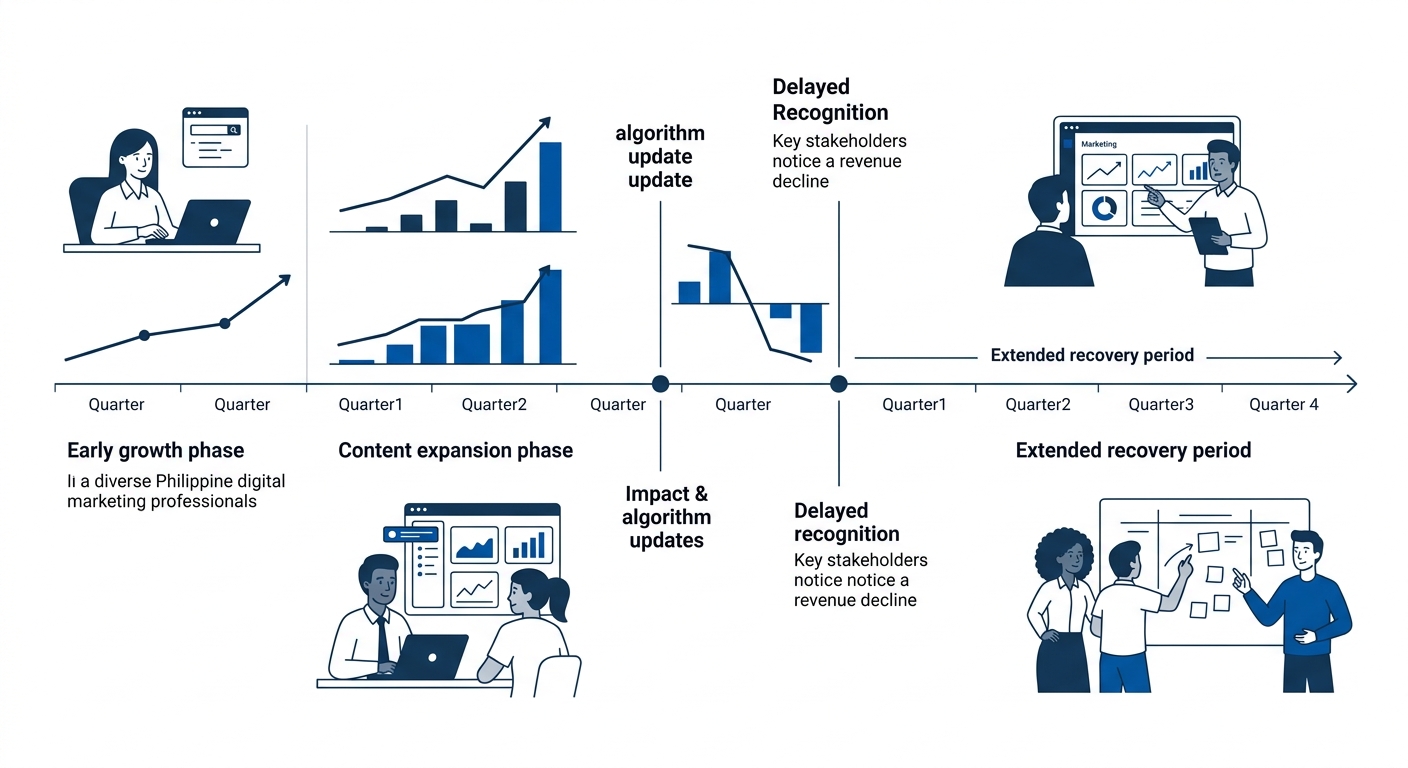
The worst quality of enterprise site architecture SEO failures is the delay between cause and consequence. Forbes’ Advisor content grew aggressively throughout 2023 and early 2024. The organic traffic decline didn’t register as a crisis until well into the second half of 2024, by which point the architectural damage had compounded across multiple Google algorithm updates and one major manual action.
This delay creates a dangerous feedback loop. The content producing affiliate revenue looks successful by its own metrics: pageviews, click-throughs to partner products, conversion events. The architectural damage it inflicts on the broader domain doesn’t surface in those reports. By the time overall organic visibility drops enough to trigger alarm, the root cause is six to twelve months in the past, buried under dozens of subsequent template changes, content publishes, and redirect additions.
And the external environment is making the stakes higher. Organic click-through rates have dropped 61% on queries where Google AI Overviews appear, according to RankMax’s enterprise SEO analysis. For enterprise sites already hemorrhaging visibility from architectural problems, AI Overviews compound the damage: fewer clicks per ranking position means the remaining organic traffic has to work harder. The organic traffic conversion gap widens from both directions. Less traffic arrives, and the traffic that does arrive encounters pages whose internal linking structure pushes visitors toward the wrong conversion paths.
The brands that caught this early treated their analytics dashboards as architecture health indicators, tracking crawl allocation by subdirectory, monitoring internal link equity distribution across content types, and flagging redirect chain growth as a leading indicator rather than a lagging audit finding. The brands that didn’t catch it are still rebuilding.
As Outpace SEO’s enterprise framework warns, a poorly executed site change “can result in losing years of accumulated domain authority and organic traffic overnight, with recovery taking months or even years.” Forbes’ situation was something slower than a botched migration and arguably worse. It was architectural drift, where incremental decisions accumulated into a structural problem that no single fix could reverse.
The Debt Ledger Forbes Left Behind
Forbes’ case resolved in the most painful way available: Google manually targeted the Advisor content, organic visibility collapsed across the domain, and the recovery road stretches into 2026 and beyond. But the architectural pattern that created the collapse persists across enterprise sites in every vertical. Mixing content types under a single domain with shared internal linking, no crawl budget segmentation, and an organizational structure where SEO lacks veto authority over structural decisions: this is the default configuration at most large enterprises, not the exception.
For enterprise brands in the Philippines operating complex product-page SEO architectures with catalogs spanning thousands of SKUs, regional microsites, and mixed content types, the Forbes pattern is instructive because it proves that domain authority alone doesn’t insulate you. Forbes had one of the strongest domains on the internet. The architecture consumed it from the inside.
Search Engine Land’s analysis of the current organic search environment frames the context directly: what’s happening represents “a structural shift in how people find information online, disrupting business models built on website traffic at the foundation”. Enterprise sites that enter this shift with clean architecture will absorb the AI Overview disruption and retain organic revenue. Enterprise sites carrying Forbes-level architectural debt, where the SEO-to-conversion gap keeps widening quarter over quarter, will discover that the 40% revenue tax was the optimistic scenario.
The information architecture audit that matters isn’t the one finding broken links. It’s the one mapping how every subdirectory, every template, and every internal link either contributes to or drains from the domain’s ability to convert organic visibility into revenue. Forbes proved what happens when that audit never gets done. The question every enterprise brand should be asking its agency and its internal teams is whether they’re accumulating the same debt while measuring the wrong signals.