B2B Attribution Guide Argues Last-Click Reporting Undervalues Top-of-Funnel Marketing Investment
A B2B attribution guide published June 13 on FYP Marketing argues that last-click reporting systematically undervalues top-of-funnel marketing activity in multi-channel campaigns, particularly for enterprise teams running cold outreach, content nurture, and sales development in parallel, according to the post.
TL;DR: The guide addresses a recurring problem for marketing leaders evaluating agency ROI: when last-click models assign full credit to final brand searches or demo-form fills, they obscure the cold emails, content touches, and retargeting sequences that created buyer intent in the first place.
The publication targets C-suite marketing decision-makers briefing agencies on performance measurement rather than practitioners executing campaigns themselves. The framing reflects a broader challenge in B2B demand generation: when multiple channels—outbound, paid media, organic content, sales follow-up—operate simultaneously over 60- to 180-day buying cycles, single-touch attribution creates blind spots in budget allocation decisions.
FYP Marketing cites research from Roivenue indicating that 70% of conversion journeys involve two or more touchpoints. That statistic underscores the structural limitation of last-click models in enterprise environments where one person receives the first cold email, another visits the site later, a third joins the sales call, and the CRM logs the opportunity after an offline conversation. In those sequences, last-click reporting typically credits the final branded search or direct visit, erasing the earlier interactions that built awareness and trust.
The Last-Click Problem in B2B Cycles
The guide identifies a recurring pattern: marketing sends a cold email to a target account, the prospect visits the site days later without replying, someone from the same company clicks a LinkedIn post the following week, sales follows up, then the prospect searches the brand name, fills out a demo form, and the CRM records the conversion as direct or organic brand traffic. Under last-click attribution, all credit lands on the final action—the demo form or brand search—while the cold email, website visit, and social engagement receive no weight.
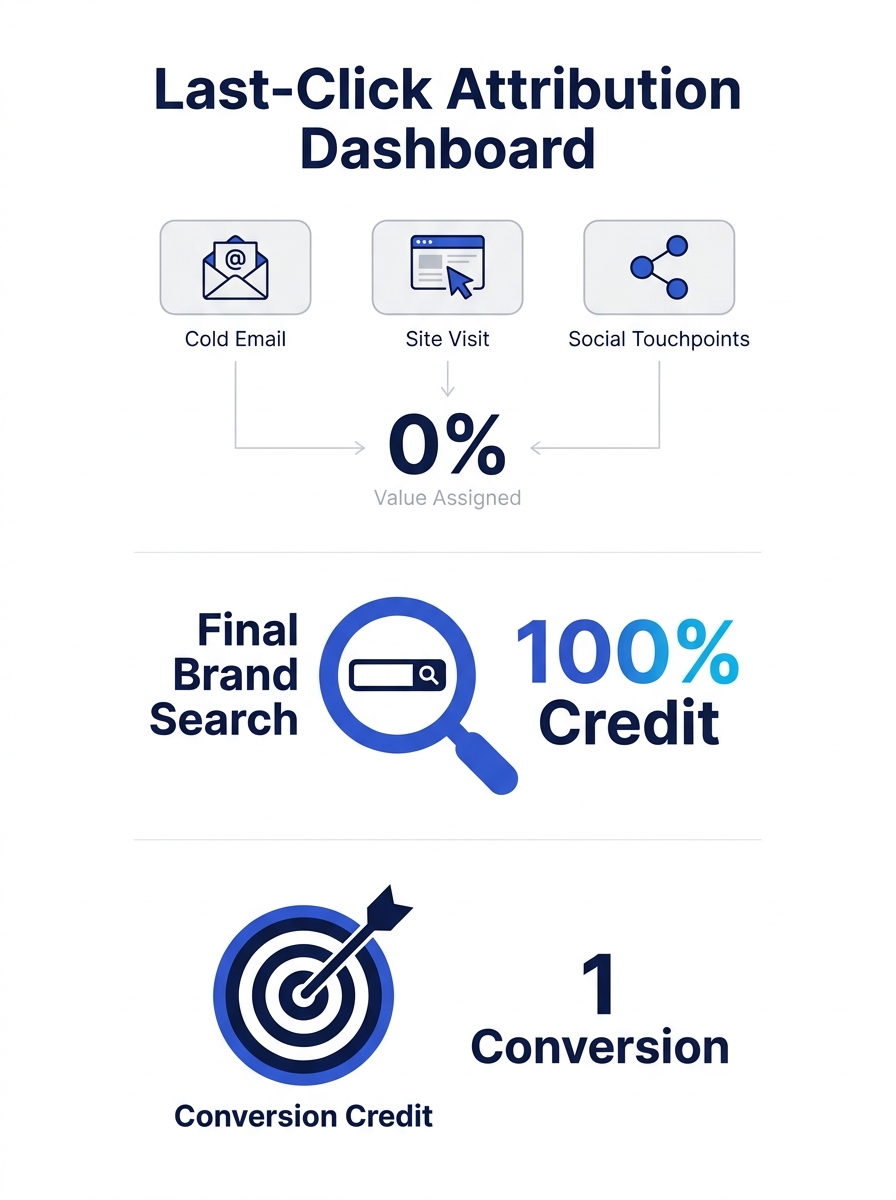
That distortion makes bottom-of-funnel channels appear stronger than they are and makes top-of-funnel work harder to defend in quarterly budget reviews, the post states. The business impact compounds when teams confuse a booked action—a form fill, a meeting scheduled—with the sequence that produced it. The guide notes that this problem surfaces frequently in performance pricing discussions, where clients evaluate whether to pay agencies per lead, per meeting, or on a retainer tied to pipeline contribution.
For marketing leaders overseeing media buying services or Google Ads management alongside organic and sales-development activity, the question isn’t whether paid search or branded campaigns drive conversions—they often do—but whether those conversions would have materialized without the earlier touches that created demand. The guide argues that single-touch models cannot answer that question because they measure the closer, not the sequence.
What Multi-Touch Attribution Tracks
Multi-touch attribution reframes the measurement question from “What was the last thing the buyer did?” to “What sequence of touches moved this account toward revenue?” The guide outlines five touchpoint categories that typically appear in B2B buyer journeys:
Outbound engagement, including cold email opens, clicks, or replies. Website behavior, such as landing page visits, pricing page sessions, or repeat returns. Content consumption, including case studies, guides, or webinar recaps. Sales interactions, including booked calls, follow-up emails, or opportunity stage changes. Paid media actions, such as clicking a search ad or seeing a retargeting sequence before returning directly.
Each touchpoint represents a moment where the account moved incrementally closer to a purchase decision. The guide compares multi-touch attribution to a relay race: one runner starts the motion, another maintains position, and a third crosses the line. Crediting only the final runner misses how the team got there.
The post distinguishes between single-touch models, where only one interaction receives credit, and multi-touch models, where several interactions share value across the full path. For enterprise brands evaluating agency partners on pipeline contribution rather than traffic volume, that distinction changes how success gets defined in the brief. A content program might generate few last-click conversions but appear consistently in the first or second touch of high-value deals. Marketing measurement frameworks increasingly reflect that nuance, particularly as AI-driven commerce platforms erode traditional attribution signals by intermediating more of the buyer journey.
The guide recommends that marketing leaders align attribution models with funnel stages—inquiry, MQL, meeting, opportunity, closed-won—rather than generic traffic metrics. That alignment allows teams to identify which channels consistently appear in journeys that convert, even when those channels don’t claim last-click credit. The useful question, the post argues, isn’t whether one touchpoint caused the deal by itself but whether it consistently appears in the paths that reach revenue.
Context and Outlook
The June 13 publication arrives as APAC enterprises face mounting pressure to justify marketing spend with pipeline-level ROI rather than top-of-funnel volume. For CMOs and marketing directors briefing agencies on campaign measurement, the guide offers a framework for setting expectations around what “attribution” means when outbound, content, paid media, and sales-development activity run in parallel. The insight that 70% of B2B journeys involve multiple touches validates what many enterprise marketing leaders already observe: meaningful deals don’t close because of a single campaign, and attribution systems that pretend they do create budget distortions.
The practical implication for agency oversight is that performance evaluation increasingly requires stitch-logic—the ability to connect touchpoints across channels, devices, and people within a single account—rather than isolated channel metrics. Marketing leaders evaluating whether an agency partner can measure multi-touch contribution should ask whether the partner’s reporting infrastructure can link a cold email sent to one contact with a website visit from another contact at the same company three weeks later, then connect both to the eventual meeting. Many legacy CRM and analytics stacks cannot.
For Philippines-headquartered enterprises and APAC growth companies operating long sales cycles—banking, insurance, real estate, pharmaceuticals—the shift from last-click to multi-touch measurement is less about adopting a new analytics tool and more about redefining what counts as “performance” when briefing or renewing an agency. The guide’s framing suggests that the question marketing leaders should bring to Q3 planning isn’t “Which channel closed the most deals?” but “Which sequence of channels consistently appears in our highest-value closed-won paths?”—and whether the current agency partner can answer that question with data rather than anecdote.