Building SEO Information Architecture for Scale: The Enterprise Framework That Compounds Organic Growth

Enterprise sites with 100,000+ URLs don’t fail at SEO because they lack content. They fail because their information architecture treats every new page as an isolated asset rather than a node in a compounding system. The structural difference between linear growth and exponential organic visibility is taxonomy, link equity distribution, and governance.
TL;DR: A scalable enterprise SEO architecture demands taxonomy defined before content creation, intent-based grouping instead of org-chart mirroring, template-level internal linking, strict click-depth enforcement, crawl-budget automation, and centralized governance. Compounding results surface around month six and accelerate between months 12 and 24.
The six rules below represent what we’ve seen work across enterprise clients managing multi-domain, multi-market digital properties. Each rule has conditions where it applies cleanly and conditions where it bends. Knowing both matters more than memorizing the rule itself.
Define your taxonomy before you publish a single page
Why does this come first? Because taxonomy is the skeleton. Every page you publish before the taxonomy is locked becomes structural debt you’ll need to migrate later. A strategic guide from Hashmeta found that the investment in correct taxonomy pays dividends across reduced customer service costs, improved conversion rates, and enhanced organic visibility. Their core finding: the most successful complex websites treat taxonomy as an ongoing discipline rather than a one-time project, with clear governance frameworks and regular user research baked into operations.
What does this look like in practice for enterprise SEO architecture? You’re defining parent categories, subcategories, and tagging conventions before a single brief goes to your content team. The taxonomy should map to the way users search, not the way your product team thinks about features.
For Philippine enterprises managing both English and Filipino content across .ph and .com domains, this step is where you decide whether regional variations sit under subdirectories (/ph/, /sg/) or subdomains. According to enterprise SEO research from WhitePress, the scope of enterprise-level SEO involves complex site architectures and multilingual initiatives designed to support scalable growth across diverse markets. Translation alone isn’t enough; content must reflect local search behavior and cultural context.
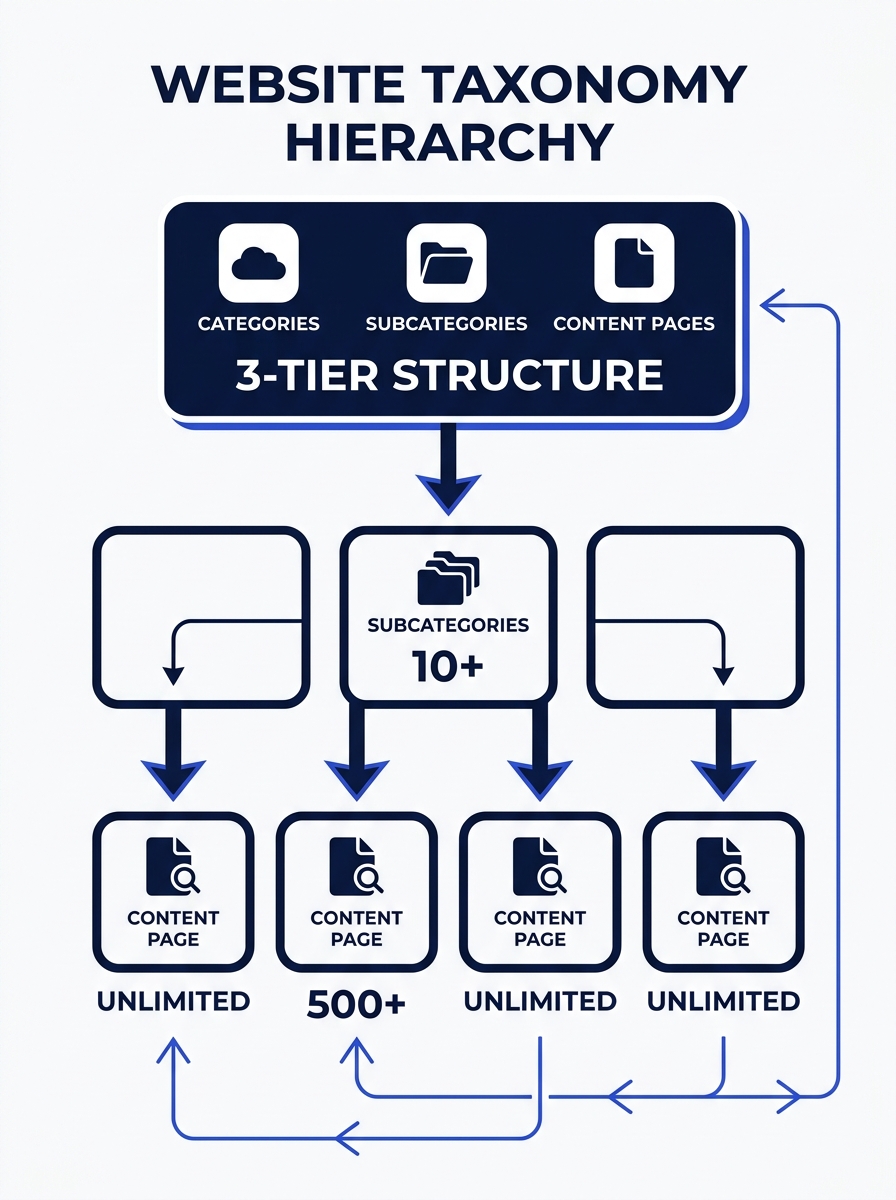
When does this rule bend? If you’re a startup with 50 pages, spending three months on taxonomy planning is overkill. This rule activates around the 500-page mark, when the cost of restructuring starts to outweigh the cost of planning.
Group pages by search intent, not by org chart
The single most common architectural mistake we see from enterprise brands is mirroring their internal departments in their URL structure. The marketing team gets /marketing/. The product team gets /products/. The support team gets /support/. The result: pages that compete with each other for identical queries because three departments all wrote content about the same customer problem.
An information hierarchy for organic growth groups pages by what users want to accomplish, not by who inside your company created the content. Your users don’t care whether the pricing page lives under the sales team’s domain or the product team’s domain. They care whether searching “enterprise CRM pricing Philippines” lands them on a single authoritative page or scatters them across four pages with 60% content overlap.
This is where content cannibalization becomes a measurable problem. When enterprise SEO backlogs hit 1,400+ tickets, a significant portion of those tickets trace back to cannibalization issues that originated in org-chart architecture decisions made years earlier.
Tip: Run a crawl of your current site and export every URL alongside its primary target keyword. Sort by keyword. If more than two URLs target the same keyword cluster, you have a grouping problem that no amount of on-page optimization will fix.
The fix requires a different mental model. Think of your site as a library organized by topic, not by which department donated the books. Map your top 200 commercial keywords into 15-25 intent clusters. Each cluster gets one pillar page and 5-12 supporting pages. That’s the SEO site structure for scalability that actually compounds.
Build internal links into page templates, not editorial workflows
An internal linking strategy at scale cannot depend on individual writers remembering to add contextual links. It breaks the moment you have 20+ content producers working across different business units. The links become inconsistent, the anchor text distribution skews toward whatever phrase each writer defaults to, and entire content clusters end up orphaned because nobody linked to them from a higher-authority page.
The solution is structural. Your CMS templates should include defined slots for related content modules, breadcrumb navigation, and contextual link blocks that populate automatically based on taxonomy tags and content relationships. According to a large-site architecture guide from Digital Applied, effective internal linking at scale requires pillar-cluster architecture, deliberate link-equity flow, controlled anchor distribution, and crawl-budget management baked into the site’s bones.
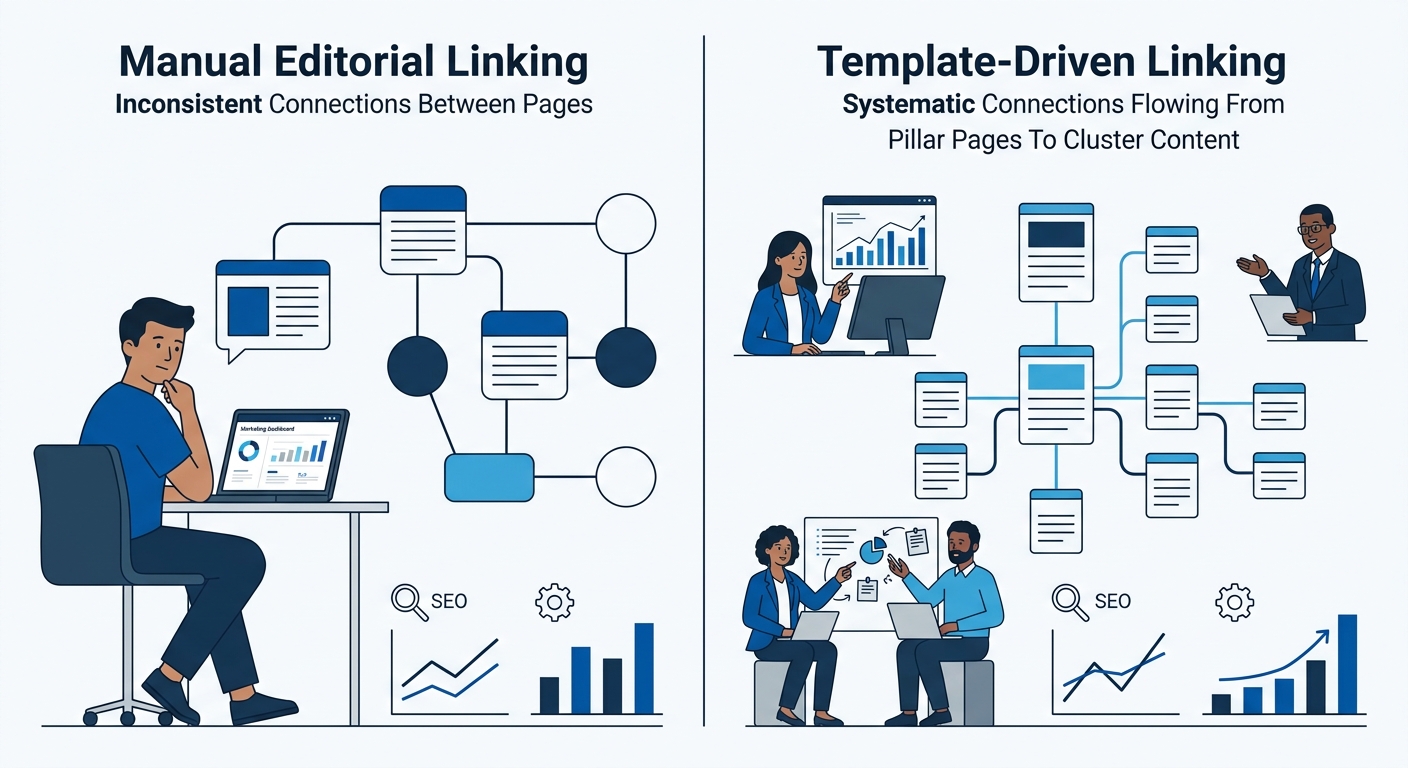
What does template-driven linking look like for an enterprise brand in the Philippines managing, say, 8,000 product pages across three categories? Each product detail page template automatically links to its parent category, to 3-4 sibling products tagged with the same attribute, and to the relevant buying guide. No writer intervention needed. The link graph builds itself as content publishes.
This pairs with how we approach enterprise SEO services for clients managing complex multi-category sites. The architecture decisions made at the template level determine whether each new page strengthens the existing graph or dilutes it.
Every page published without a template-enforced linking structure is a lottery ticket. Some will get discovered. Most will sit in an index with no internal authority pointing at them.
Cap your click depth at three levels from root
Click depth is the number of clicks required to reach a page from the homepage. Research on crawl behavior consistently shows that pages buried four or more clicks deep receive significantly fewer crawl visits, accumulate less PageRank, and index more slowly.
For sites with 100,000+ URLs, keeping everything within three clicks sounds impossible. It’s achievable through two mechanisms: faceted navigation that surfaces deep pages through filtered category views, and hub pages that aggregate content by theme and sit at level two. The math works if your level-one pages (main navigation categories) each link to 20-40 level-two hubs, and each hub links to 30-80 level-three detail pages. That’s 20 × 40 × 80 = 64,000 pages reachable within three clicks, before you account for cross-links and footer navigation adding more pathways.
When enterprises we work with run technical SEO audits that prioritize fixes by impact, click depth is one of the first diagnostics. Pages sitting at depth five or six often show indexation rates below 40%, while pages at depth two or three index at rates above 85%.
This rule does break for certain site types. Large e-commerce catalogs with millions of SKUs can’t physically keep every product at depth three. In those cases, the priority is ensuring that your top 20% of revenue-generating pages sit within three clicks, with XML sitemaps and internal link velocity compensating for the deeper long-tail pages.
Automate crawl-budget hygiene before scaling content
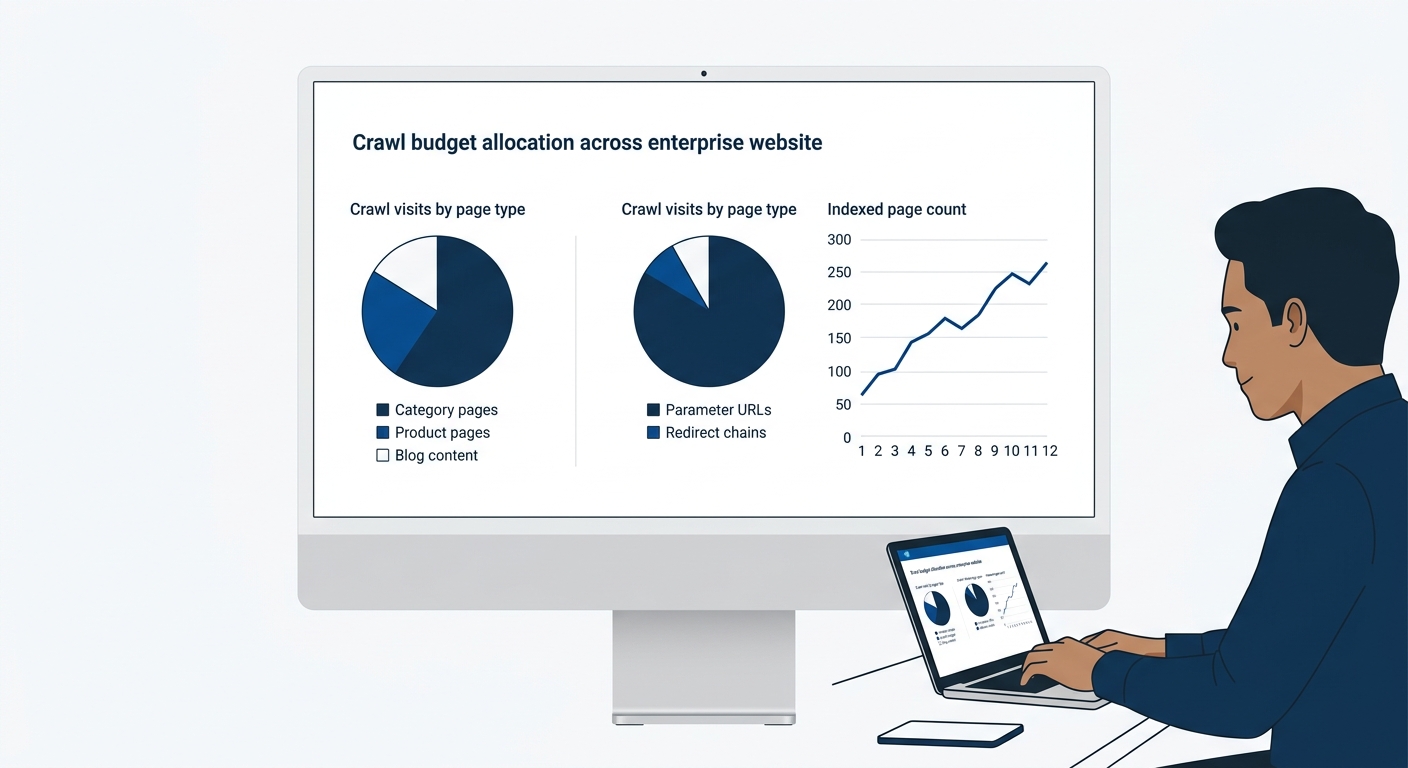
Adding 500 new pages per month to a site that wastes 35% of its crawl budget on parameter URLs, soft 404s, and redirect chains is the SEO equivalent of pouring water into a bucket with holes. Google’s crawlers have a finite allocation for your domain. If that budget gets consumed by low-value pages, your new high-value content sits in a queue.
For sites exceeding 1 million URLs, logfile analysis is the primary diagnostic tool. It reveals which pages Googlebot actually visits versus which pages you assume it visits. The gap between those two numbers tells you how much crawl budget you’re wasting. Enterprises managing content strategy and production at scale need this data before they greenlight any content calendar expansion.
Automation here means three things: scheduled crawl audits that flag new parameter URLs or duplicate content clusters within 48 hours of publication, automated canonical tag enforcement at the template level, and rules-based robots.txt management that responds to crawl log patterns rather than waiting for a quarterly manual review.
An in-house SEO upskilling program should include crawl-budget analysis as a core module. Too many enterprise marketing teams commission content without understanding that their site’s technical foundation determines whether that content will ever appear in search results.
Assign a center of excellence to govern the architecture
Every rule above eventually fails without centralized ownership. Taxonomy drifts when new product lines launch without consulting the IA document. Internal links break when someone redesigns a section and changes the URL structure. Click depth creeps upward when a stakeholder insists on adding a new navigation tier for their division.
The center of excellence (CoE) model assigns a cross-functional team with authority to approve or reject structural changes to the site. This team typically includes an SEO lead, a UX architect, a front-end developer, and a representative from the content organization. They own the taxonomy document, the URL convention guide, the redirect protocol, and the template link specifications.
Enterprise platforms with unified reporting and cross-domain performance tracking, as described by BrightEdge’s enterprise criteria, give the CoE the data layer they need. Tracking millions of keywords across multiple domains and measuring performance holistically or by individual domain requires centralized workflow management. Without it, each business unit optimizes locally and damages the global architecture.
The CoE meets biweekly, reviews proposed URL additions against the taxonomy, audits crawl-budget reports, and flags cannibalization risks before they compound into the kind of traffic that doesn’t convert. This is governance, and governance is what turns a well-designed architecture into one that stays well-designed 18 months later.
Warning: A center of excellence with advisory authority but no veto power becomes an ignored Slack channel within two quarters. The CoE needs to be able to block a URL launch that violates the taxonomy.
When the Framework Stops Compounding
These six rules assume a certain kind of enterprise: large enough to have structural complexity, mature enough to enforce governance, and patient enough to wait for compounding to kick in between months 12 and 24. The framework weakens under three specific conditions.
First, when the business model changes faster than the architecture can adapt. A company that pivots from B2B to B2C mid-year will find that its intent-based page groupings no longer match its new audience’s search behavior. In that scenario, speed of restructuring matters more than architectural elegance.
Second, when Google’s own search interface reduces the value of organic clicks. As we’ve explored in the context of Google’s AI search redesign and its impact on traffic, an architecture optimized for click-through may need to be re-evaluated for citation and brand visibility in AI-generated answers. Entity clarity and brand authority beyond rankings become the metrics that matter when the click itself is no longer guaranteed.
Third, when the organization lacks the cross-functional buy-in to sustain a CoE. Architecture is a political problem as much as a technical one. If the VP of Product can override taxonomy decisions without SEO review, the framework erodes from the top.
Under those conditions, the right move is to tighten scope. Govern fewer pages more strictly rather than governing the entire domain loosely. Protect your top 500 revenue-generating URLs with rigid architectural rules and let the long tail operate with lighter governance. A partial framework that holds is worth more than a complete framework that nobody follows.