Google Embeds Top Stories Inside AI Overviews on 15.5% of Trending Queries, Blocking via Robots.txt Ineffective

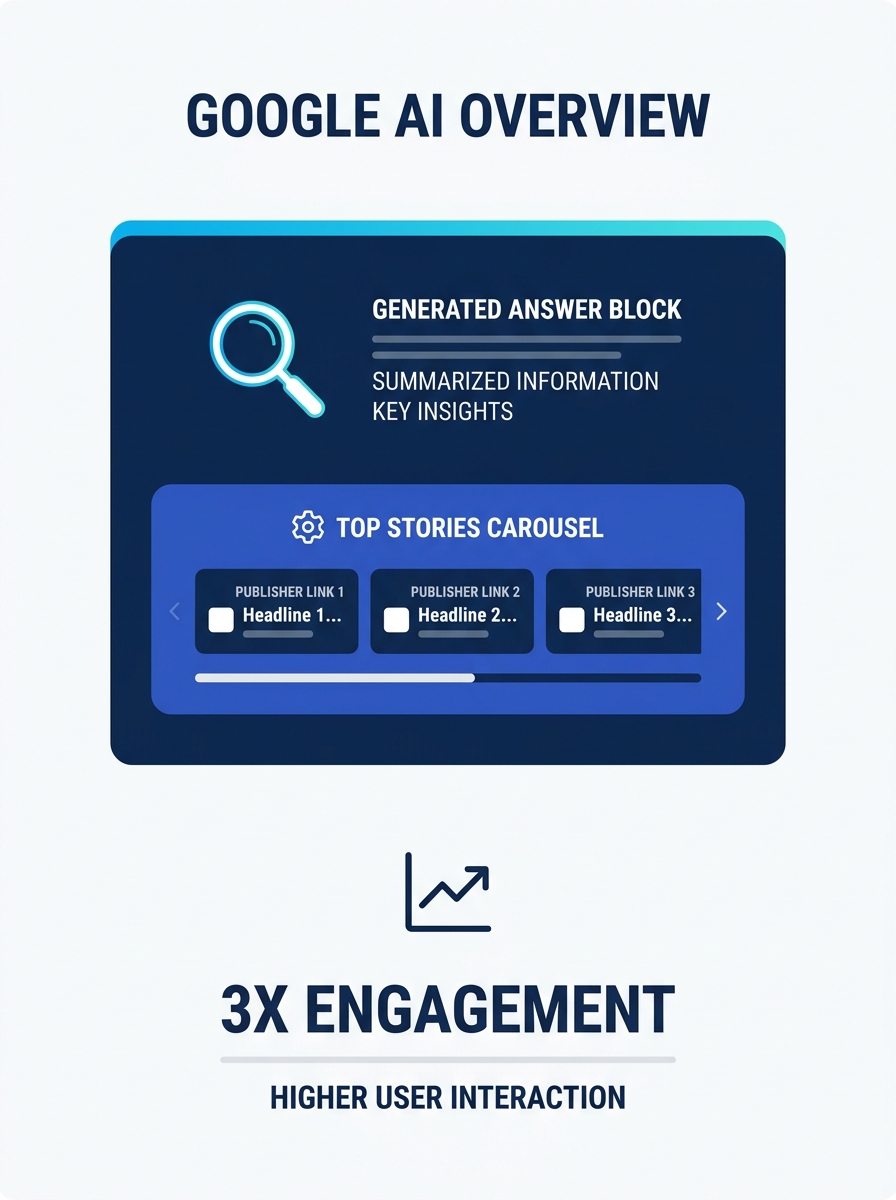
Top Stories carousels now appear embedded directly inside Google AI Overviews on 15.5 percent of U.S. trending news queries, a placement that publishers cannot block via robots.txt, according to tracking data released by NewzDash CEO John Shehata in July 2026.
TL;DR: Google places Top Stories inside AI Overviews on nearly one in six trending queries, and the robots.txt directive most publishers use to opt out does not affect this placement.
The finding exposes a widespread misunderstanding about how publishers control their visibility in AI-powered search surfaces. NewzDash tracked trending news queries across the U.S. and UK where Google displays Top Stories and found that when the carousel appears inside an AI Overview, Google does not also show a separate Top Stories module further down the page for the same query. The placements are mutually exclusive, making the embedded version a direct substitution rather than an additional exposure point.
For marketing leaders overseeing enterprise digital presence and agency partnerships, the discovery reframes how search visibility operates when AI-generated answers dominate the results page. The same measurement gap that affects only 38 percent of cited pages now extends to news and trending-topic queries where traditional Top Stories placement offered predictable tracking.
Entertainment and World News Queries Show Highest Embedding Rates
NewzDash’s data shows entertainment queries lead both countries in embedding frequency, reaching 35 percent of relevant queries in the U.S. and 31.5 percent in the UK. World News queries hit nearly 32 percent in the U.S., according to Shehata’s LinkedIn post and accompanying blog analysis.
The UK market shows a slightly higher overall rate at 17.46 percent compared to the U.S. baseline of 15.5 percent. Health and Science queries register minimal embedding, suggesting Google applies the format selectively by topic category.
Shehata emphasized in his disclosure that when Top Stories appears inside the AI Overview, Google removes the standalone carousel that would normally appear below the generated text. Publishers seeing traffic from Top Stories placements cannot currently distinguish which format delivered the click without inspecting individual query patterns, a distinction that matters when evaluating whether to opt out of AI surfaces entirely.
Google-Extended Does Not Control AI Overviews Inclusion
The most common publisher response to AI Overviews since launch—blocking Google-Extended in robots.txt—does not prevent Top Stories from appearing inside AI-generated answers. Google’s crawler documentation states that Google-Extended governs specified AI training and certain Vertex AI grounding uses but explicitly does not affect a site’s inclusion in Google Search or function as a ranking signal.
“Google-Extended does not affect how your site appears in Google Search, including AI Overviews, or how it’s used to improve Search,” the documentation reads. Blocking the crawler removes a site from future Gemini model training and certain enterprise AI products but leaves it fully eligible for Top Stories, AI Mode, and the embedded carousel placement NewzDash documented.
The confusion is industry-wide, not fringe. Shehata’s repeated emphasis on the distinction reflects how many publishers believed they had already opted out of AI Overviews when they had only blocked a training pathway.
Search Console Setting Offers Actual AI Overviews Control—With Unknowns
Google began testing a generative AI exclusion control inside Search Console in June 2026, currently limited to a subset of UK site owners. The setting allows eligible publishers to exclude their links and content from AI Overviews, AI Mode, and generative Discover features specifically, without affecting traditional Search eligibility.
According to Google’s support documentation, an excluded site’s content will not appear in those features and will not be used as an input for generating a response. Shehata’s interpretation, labeled high-confidence rather than documented, is that choosing exclusion would also remove a publisher from the embedded Top Stories carousel since it rides inside one of the covered surfaces.
What happens next at the layout level remains undocumented. Google has not confirmed whether AI Overviews would continue showing an embedded carousel built only from opted-in publishers, whether the platform would fall back to a standalone Top Stories module, or whether the feature would disappear entirely for that query. The ambiguity leaves marketing teams and their AI SEO agency partners without the information needed to model the visibility trade-off before making the exclusion decision.
Pattern Echoes 2007 Universal Search Integration
The mechanism parallels Google’s 2007 rollout of Universal Search, when the platform began blending News, Video, Images, and other vertical results into the main web rankings. Danny Sullivan described that May 2007 launch as the most radical change Google had shipped to its results, moving from separate verticals users navigated individually to one integrated ranked list.
Shehata and Search Engine Journal contributing editor Roger Montti discussed the pattern shift publicly in 2006 during a Search Engine Strategies conference panel on “Vertical Creep Into Regular Search Results,” noting how Google was already pulling News content into web results before the formal Universal Search announcement.
The 2026 version places the integrated content inside an AI-generated answer rather than a blended organic list, but the structural logic—consolidating formerly separate surfaces into a primary experience—remains identical.
APAC. Implications
For Philippine enterprises and APAC-headquartered brands with regional search visibility goals, the Top Stories integration into AI Overviews creates a compliance gap that most agency briefings do not yet account for. Marketing leaders evaluating enterprise digital marketing services should confirm the agency’s measurement framework explicitly tracks AI Overview placements separately from traditional Top Stories, and that any opt-out recommendation specifies which Search Console setting applies rather than defaulting to robots.txt directives that leave the core visibility issue unchanged.
The finding also surfaces an authority signal that works differently in AI-generated answers than in traditional organic results. When Google embeds Top Stories inside an AI Overview rather than separating it below the generated text, the platform is effectively citing named publishers and real bylines as evidentiary support for the answer itself. That changes the editorial threshold: brands relying on newsjacking tactics or thin commentary may find their URLs excluded from the embedded carousel even when they would have appeared in a standalone Top Stories module, because Google is now using those links to anchor credibility inside a synthesis rather than offering them as parallel alternatives.
Agencies managing client expectations around trending-topic visibility should model two scenarios in their reporting—one where Top Stories placement occurs in the traditional standalone module, delivering measurable referral traffic with attribution clarity, and one where the same placement occurs inside an AI Overview and competes for user attention against the generated summary surrounding it. The latter scenario reduces click probability but may increase citation frequency if Google treats the embedded publishers as a trust layer, a trade-off that enterprise brands with established newsroom operations may accept differently than growth-stage companies relying on SEO traffic to fuel acquisition funnels.