General Electric Built a Multi-Platform Media Operation Rivaling Mid-Size Publishers While Marketing Industry Focused on Branded Content Theory

General Electric constructed an in-house content operation producing original podcasts, virtual reality experiences, and platform-specific editorial across Tumblr, Instagram, and Medium between 2014 and 2018, yet the advertising industry that championed “brand storytelling” as conference-circuit doctrine treated the Fortune 10 company’s transformation as an isolated curiosity rather than a replicable framework, according to analysis published by Direct Message News on June 5.
TL;DR: GE built a publisher-scale owned media infrastructure spanning podcasts, social platforms, and long-form editorial while the marketing industry applauded branded content concepts but ignored the structural execution, revealing a gap between stated innovation values and actual adoption of owned-media economics.
The disconnect between industry rhetoric and observed behavior surfaced as GE deployed resources across multiple content formats. The company launched “The Message,” a science-fiction podcast that climbed to the top of iTunes charts. It developed a Tumblr presence recognized for scientific storytelling and unexpected wit. Its Instagram account showcased industrial processes with design-magazine aesthetic standards. On Medium, GE published long-form explorations of infrastructure technology and energy systems.
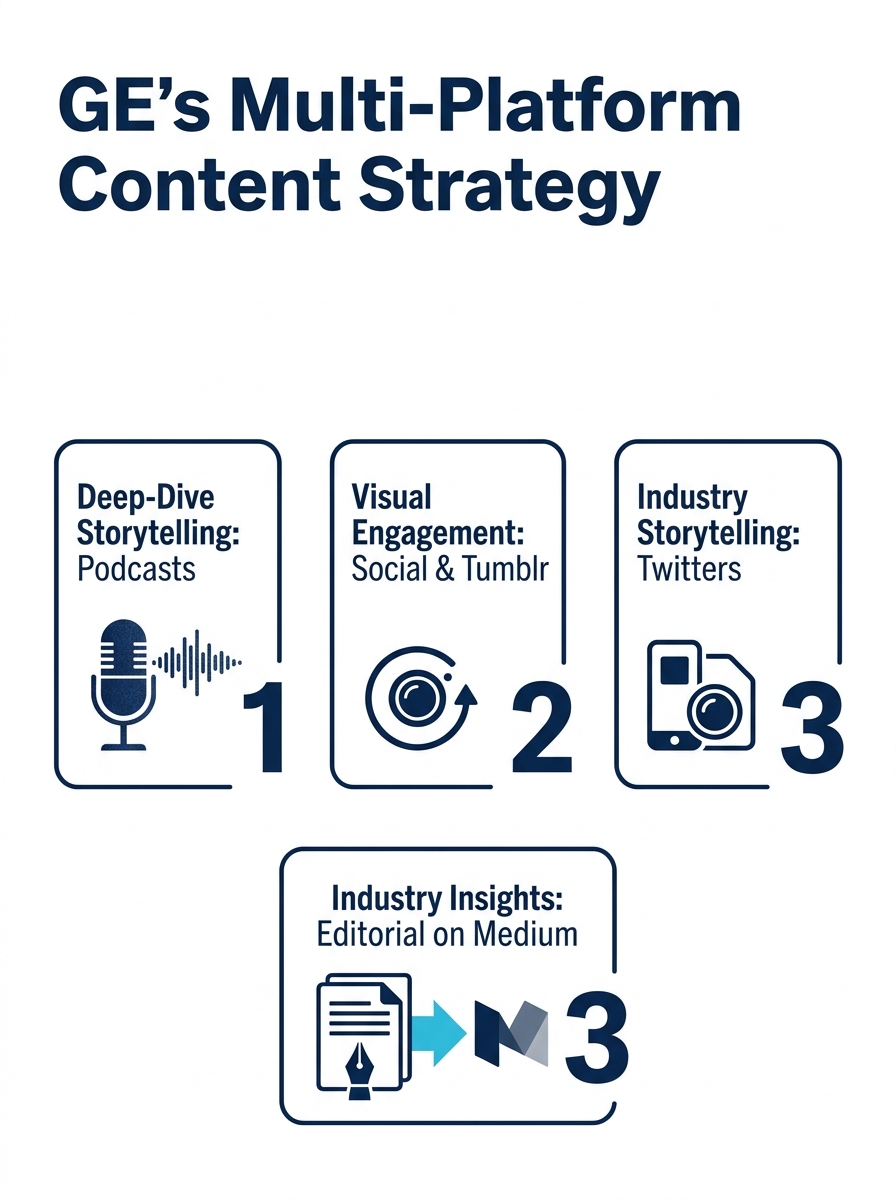
Linda Boff, then Executive Director of Global Brand Marketing at GE, described the company as “leaning in” to native advertising during the period, a phrase signaling strategic posture rather than experimental testing. Forbes separately analyzed GE’s campaign featuring software developer character Owen, designed to reposition the 130-year-old industrial conglomerate as a digital-industrial employer competing for engineering talent against Silicon Valley startups.
Industry Response Pattern Exposed Doctrine-Practice Gap
The advertising trade press covered individual GE initiatives as isolated tactics—brief write-ups on each podcast launch or platform activation—without connecting them into the structural transformation they represented. Conference stages during the same period filled with speakers advocating “thinking like a publisher” and agencies released white papers on brand storytelling, yet sustained analysis of a Fortune 10 company executing that doctrine at scale remained absent from industry publications.
The pattern revealed what Direct Message News characterized as uncomfortable economics: serious commitment to owned media infrastructure threatens the agency model’s revenue logic, the traditional media buy’s purchasing mechanics, and the assumption that brands should rent attention through interruptive advertising rather than build capability to earn sustained audience relationships. GE’s execution raised questions the existing ecosystem preferred to defer.
Structural forces documented in the analysis made the broadcast model increasingly untenable. Audience fragmentation across expanding channel counts, ad-blocking tool adoption by 198 million internet users globally, on-demand consumption expectations from digital-native cohorts, and participatory audience behavior that remixes and redistributes content rather than passively receiving it drove GE’s strategic response. The company recognized that owning distribution infrastructure had become a competitive requirement, not an experimental tactic.
Buzzword Saturation Absorbed Disruptive Signal
Marketing discourse metabolized GE’s transformation through trend-cycle mechanics that favor novelty over depth. “Branded content” became overused to the point of losing distinction between sponsored listicles and full-scale media operations. “Transmedia storytelling” circulated through conference presentations until collapsing under abstraction weight. The industry rebranded these concepts as “brand storytelling” in what amounted to repackaging rather than genuine reckoning with underlying media-infrastructure shifts.
The gap between applause for innovation concepts and silence around execution at publisher scale points to a contradiction in modern marketing behavior. Awards ceremonies create new categories for branded content. Keynotes invoke the need for brands to “add value” and “become part of culture.” But when a legacy industrial giant commits capital and organizational structure to becoming an actual media company, the industry treating it as precedent-setting would acknowledge that building authority through owned content platforms requires resource allocation fundamentally different from campaign-based thinking.
The Forbes campaign analysis examined how GE confronted perception gaps between what the company manufactured—industrial Internet-of-Things systems, turbines, medical imaging equipment—and public assumptions about employment brand positioning. The “Owen” creative targeted software engineering talent by reframing GE as a technology employer rather than traditional manufacturing employer, addressing a strategic workforce acquisition challenge through narrative repositioning. That campaign ran parallel to the owned-media infrastructure build, not as a replacement for it.
APAC. Implications
Marketing leaders at APAC enterprises evaluating content strategy proposals from agency partners face the same doctrine-practice gap that muted industry response to GE’s publisher transformation. Conference presentations and white papers advocating “brand storytelling” are abundant; case studies documenting multi-year organizational commitment to owned media infrastructure, platform-specific content creation capability, and audience-building disciplines that compound over quarters rather than campaigns remain scarce.
The resource allocation question GE answered—whether to rent attention through paid media or invest in earning it through owned platforms—applies directly to banking, real estate, pharma, and insurance brands briefing agencies in 2026. Platform fragmentation has accelerated since GE’s initial build: TikTok, YouTube Shorts, LinkedIn newsletters, Threads, and podcast distribution channels now demand format-specific content creation. Ad-blocking adoption continues to rise. The structural forces that made GE’s approach rational have intensified, yet the marketing ecosystem still organizes around campaign cycles and media buys rather than publishing operations.
When evaluating agency partners or internal content capability, the GE precedent suggests questions beyond creative brief approval. Does the proposed structure build compounding audience relationships or rent temporary attention? Does resource allocation reflect publisher economics—staffing for consistent output cadence, platform expertise, data-driven editorial—or campaign thinking? The gap between what marketing leaders say they value and what organizational structures actually fund determines whether content becomes strategic infrastructure or remains a buzzword absorbed into the next trend cycle.