How to Choose the Right SEO Company for Your Business
Choosing an SEO company is not just about finding a vendor that knows how to improve rankings. It is about finding a partner that understands your business goals, works transparently, and can turn organic search into qualified traffic, leads, and revenue.
That matters because SEO takes time. A weak agency can waste months chasing vanity metrics, publishing the wrong content, or fixing the wrong issues. A strong one can help you build a sustainable search engine optimization strategy that supports long-term growth.

If you’re evaluating providers, here is how to choose an SEO company more carefully.
Start with your business goals, not the agency pitch
Before you compare SEO providers, get clear on what success should look like for your business.
For example, are you trying to:
- generate more qualified leads
- improve local visibility
- grow ecommerce revenue
- recover from a traffic decline
- support a site relaunch
- build long-term organic authority in a competitive category
If your goals are vague, every agency pitch will sound good.
A good SEO partner should be able to connect search work to business outcomes. That means they should ask about your offer, margins, sales cycle, target locations, and conversion paths before recommending a plan.
If an agency jumps straight to rankings without understanding the business, that is an early warning sign.
Make sure they can explain how SEO fits your growth strategy
A credible provider should be able to explain where SEO fits in your broader marketing mix.
That includes how SEO interacts with:
- your website structure
- your content strategy
- your technical setup
- your conversion path
- your paid media and retargeting efforts
- your sales process
According to Google’s SEO Starter Guide, search performance depends on making content accessible, useful, and understandable to both users and crawlers. In practice, that means SEO is rarely just a keyword exercise. It usually touches content quality, internal linking, technical health, and page experience.
If an agency treats SEO like a standalone trick instead of part of a broader digital growth system, be cautious.
Look for a clear process, not vague promises
When you ask how they work, a strong SEO company should be able to walk you through a clear process.
That process will usually include:
- discovery and goal alignment
- technical and content audit
- keyword and search-intent research
- content and on-page optimization plan
- internal linking and site architecture improvements
- authority-building or link acquisition strategy
- reporting, iteration, and prioritization
The exact order can vary, but the point is that there should be a system.
If the answer sounds like “we’ll optimize your site and get you ranking,” push deeper. Ask what they actually audit, how they prioritize, how they handle technical issues, and how they decide which pages should target which queries.
Ask what they would do in the first 90 days
This is one of the fastest ways to separate strategic agencies from sales-heavy ones.
A serious provider should be able to describe what the first 30, 60, and 90 days would look like.
For example:
- First 30 days: audit, baseline metrics, research, quick technical fixes, priority-page review
- Days 31 to 60: on-page improvements, content planning, internal link updates, implementation roadmap
- Days 61 to 90: initial content rollout, authority-building, reporting, refinement based on early signals
They do not need to give away their full playbook for free. But they should be able to show they know how to sequence the work.
If there is no clear prioritization, expect a messy engagement.
Review case studies carefully
Most agencies can show a nice-looking case study. The better question is whether the case study proves the kind of outcome you actually care about.
When reviewing case studies, look for:
- the starting problem
- the type of business and market
- the scope of work
- the timeline
- the metrics used
- whether the results tie back to leads, revenue, or qualified traffic
It is also fair to ask whether the example reflects a typical engagement or a best-case outlier.
A case study is much more useful when it shows context and trade-offs rather than just a growth chart.
Ask what they measure and report on
A trustworthy agency should report on metrics that help you make decisions, not just metrics that make the agency look busy.
Useful reporting often includes:
- organic traffic quality
- non-branded visibility
- target keyword movement for pages that matter
- conversions or lead actions from organic traffic
- landing page performance
- content performance by intent
- technical issues found and resolved
- work completed, blocked, and next priorities
Be careful with reports that focus too heavily on rankings without context.
A movement from position 18 to 9 may matter more than a handful of new low-value keywords in the top 3. What matters is whether the work is improving discoverability for commercially relevant searches.
Evaluate how they talk about content
A lot of SEO agencies still talk about content as if it is just a vehicle for inserting keywords. That is outdated thinking.
A stronger agency should be able to explain:
- how they identify search intent
- how they map topics to existing pages
- how they avoid cannibalization
- how they decide between new content and refreshing old content
- how content supports service pages and conversion goals
For example, if your business needs to strengthen its service visibility, the right approach is often to pair commercial service pages with supporting educational content. That kind of structure helps both users and search engines understand topical authority.
If content planning is part of your priority, ask whether the agency can connect blog strategy to your broader SEO services roadmap.
Ask about technical SEO in plain language
You do not need a provider to overwhelm you with jargon. But they should be able to explain what technical issues matter for your site and why.
That might include:
- crawlability and indexability
- canonicalization
- redirect handling
- duplicate content
- site architecture
- internal linking
- page speed and performance bottlenecks
- structured data where relevant
A good agency can simplify technical concepts without dumbing them down.
If technical SEO is a meaningful part of your growth challenge, ask how they handle audits, implementation support, and prioritization. If they cannot speak clearly about technical work, they may not be equipped to solve deeper visibility problems.
Watch for red flags before you sign
Some warning signs show up early.
1. Guaranteed rankings
No agency controls Google’s algorithms. Be skeptical of guaranteed rankings, guaranteed traffic numbers, or unrealistic timelines.
2. No explanation of methodology
If they cannot explain how they work, what they prioritize, or why they recommend certain actions, that is a problem.
3. Overemphasis on vanity metrics
More keywords and more traffic are not enough by themselves. You want qualified visibility tied to business goals.
4. One-size-fits-all packages
Different businesses need different strategies. A local service brand, ecommerce site, and enterprise website should not all get the same playbook.
5. Weak communication
SEO requires alignment across stakeholders. If the agency is unclear, evasive, or slow before the contract begins, that often gets worse later.
6. No ownership over implementation
Some agencies only deliver slides. Others help you execute. Clarify whether they are advising, implementing, or both.
7. They do not review your site before the pitch
If they have not looked at your site, market, or competitors, expect generic recommendations.
Ask these questions before hiring an SEO company
If you’re comparing options, use these questions during the evaluation process:
- What would you prioritize in the first 90 days for our site?
- How do you decide between creating new pages and improving existing ones?
- What does your audit process cover?
- Which KPIs do you report on monthly?
- How do you measure qualified traffic or lead quality from SEO?
- What work is handled in-house, and what is outsourced?
- How do you approach technical SEO issues?
- How do you build or earn links without using risky tactics?
- What does collaboration look like with our internal team or developer?
- Can you show case studies similar to our business model or market?
You are not just checking expertise. You are checking whether the agency’s way of working fits your team and growth goals.
Know the difference between a vendor and a growth partner
The best SEO agencies do more than complete a checklist.
They help you make better strategic decisions about:
- which opportunities are worth pursuing
- which pages should own which intent
- where technical issues are holding back growth
- how content should support demand capture
- how SEO should connect with the rest of your digital strategy
That is a more valuable relationship than simply outsourcing title tags and blog posts.
If your site also depends on stronger authority signals, ask how they approach assets like link building services and whether those tactics are integrated into the broader SEO plan instead of treated as a disconnected add-on.
Choose the agency that shows judgment
In the end, hiring the right SEO company is less about who sounds the most confident and more about who demonstrates the best judgment.
A strong agency should be able to:
- understand your business goals
- explain their process clearly
- prioritize work based on impact
- communicate trade-offs honestly
- show relevant proof of execution
- focus on sustainable growth rather than shortcuts
That is what gives you a better chance of finding an SEO partner that can support long-term performance rather than short-term noise.
If you are evaluating providers and want a clearer view of what your site actually needs first, start with an SEO conversation grounded in business goals, site realities, and search intent — not just generic promises.
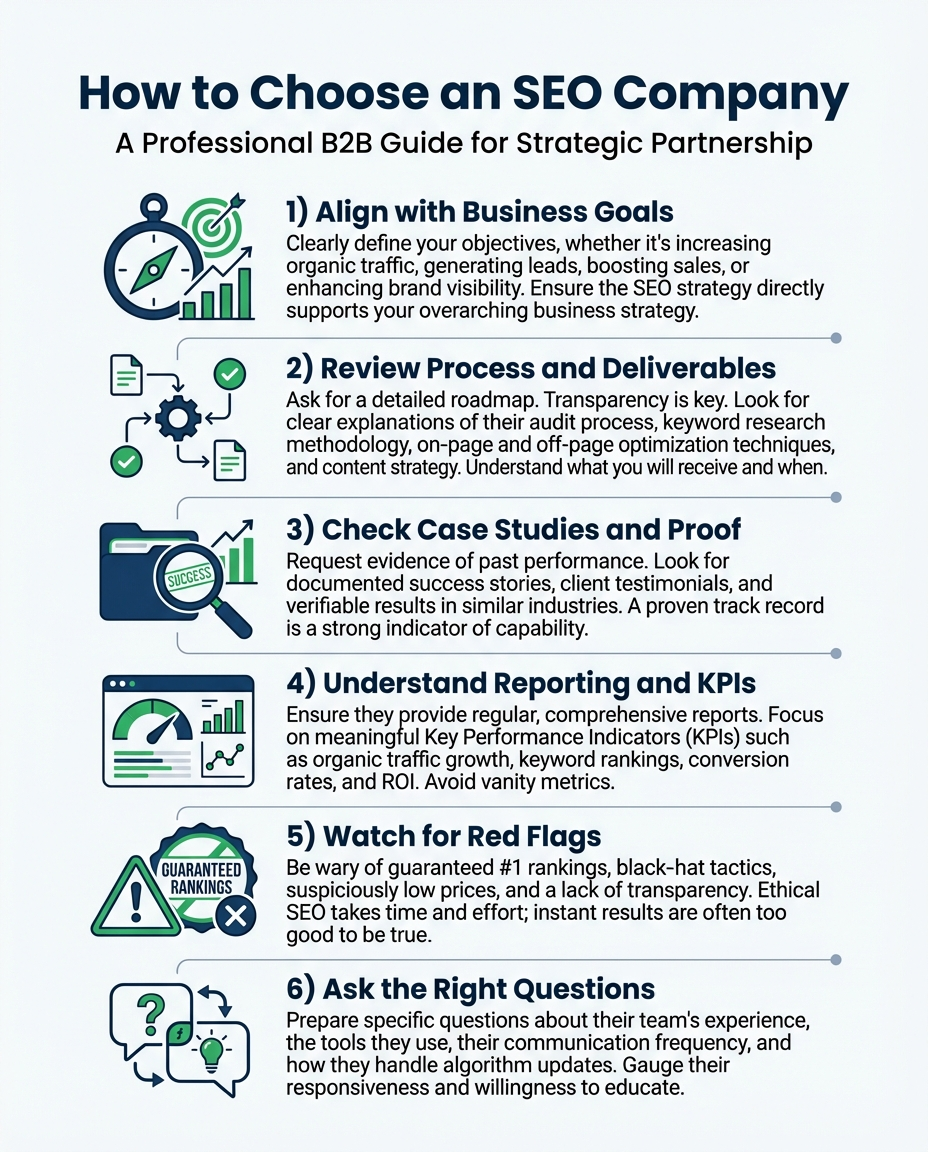
Final checklist: how to evaluate an SEO company
Before you sign, make sure you can confidently answer yes to these questions:
- Do they understand our business goals?
- Can they explain their process in concrete terms?
- Have they shown relevant case studies or proof of work?
- Do they report on meaningful KPIs?
- Are they realistic about timelines and outcomes?
- Can they support both strategic planning and execution?
- Do they understand content, technical SEO, and authority-building together?
- Do we trust how they think, not just how they sell?
If the answer is no to several of those, keep looking.
The cost of choosing the wrong SEO company is not just financial. It is lost time, lost momentum, and lost search visibility.