What is Content Marketing: A Guide For Businesses

Content marketing has evolved from a nice-to-have tactic to an essential business strategy. With global content marketing revenue projected to reach $107 billion in 2026, businesses that master content creation and distribution gain significant competitive advantages.
For Philippine businesses navigating an increasingly digital marketplace, understanding what content marketing is—and how to do it effectively—can mean the difference between thriving and merely surviving online.
What is Content Marketing?

Content marketing is the strategic process of creating, publishing, and distributing valuable content to attract, engage, and convert your target audience. Unlike traditional advertising that interrupts consumers with promotional messages, content marketing provides genuine value that audiences actively seek out.
According to DemandSage research, 82% of modern businesses now use content marketing as a core strategy. The adoption rate climbs to 97% for large enterprises and reaches 93% in B2B markets.
Key elements of content marketing include:
- Strategic planning: Aligning content with business goals and audience needs
- Value creation: Producing content that educates, entertains, or solves problems
- Consistent publishing: Maintaining regular content cadence across channels
- Audience targeting: Reaching the right people at the right time
- Performance measurement: Tracking results and optimizing based on data
Why Content Marketing Matters in 2026
The business case for content marketing has never been stronger. Research shows content marketing generates an average return of $7.65 for every dollar invested—significantly outperforming traditional marketing channels.
Building Trust and Authority
Consumers today research extensively before making purchasing decisions. When your brand consistently provides helpful, accurate content, you establish yourself as a trusted authority in your industry.
This is particularly important in the Philippine market, where relationship-building and trust play crucial roles in business transactions. Quality content demonstrates your expertise without the hard sell that many consumers have learned to tune out.
Driving Organic Traffic
Content marketing and SEO work hand in hand. Every piece of valuable content you create is an opportunity to rank for relevant search terms and attract qualified visitors to your website.
According to BrightEdge, organic search drives 53% of all website traffic. Content marketing fuels that organic visibility with material search engines—and users—find valuable.
Supporting the Entire Customer Journey
Content marketing isn’t just about attracting new prospects. Effective content strategies support customers at every stage:
- Awareness: Educational blog posts, infographics, and social content
- Consideration: Comparison guides, case studies, and webinars
- Decision: Product demos, testimonials, and detailed specifications
- Retention: Tutorials, newsletters, and community content
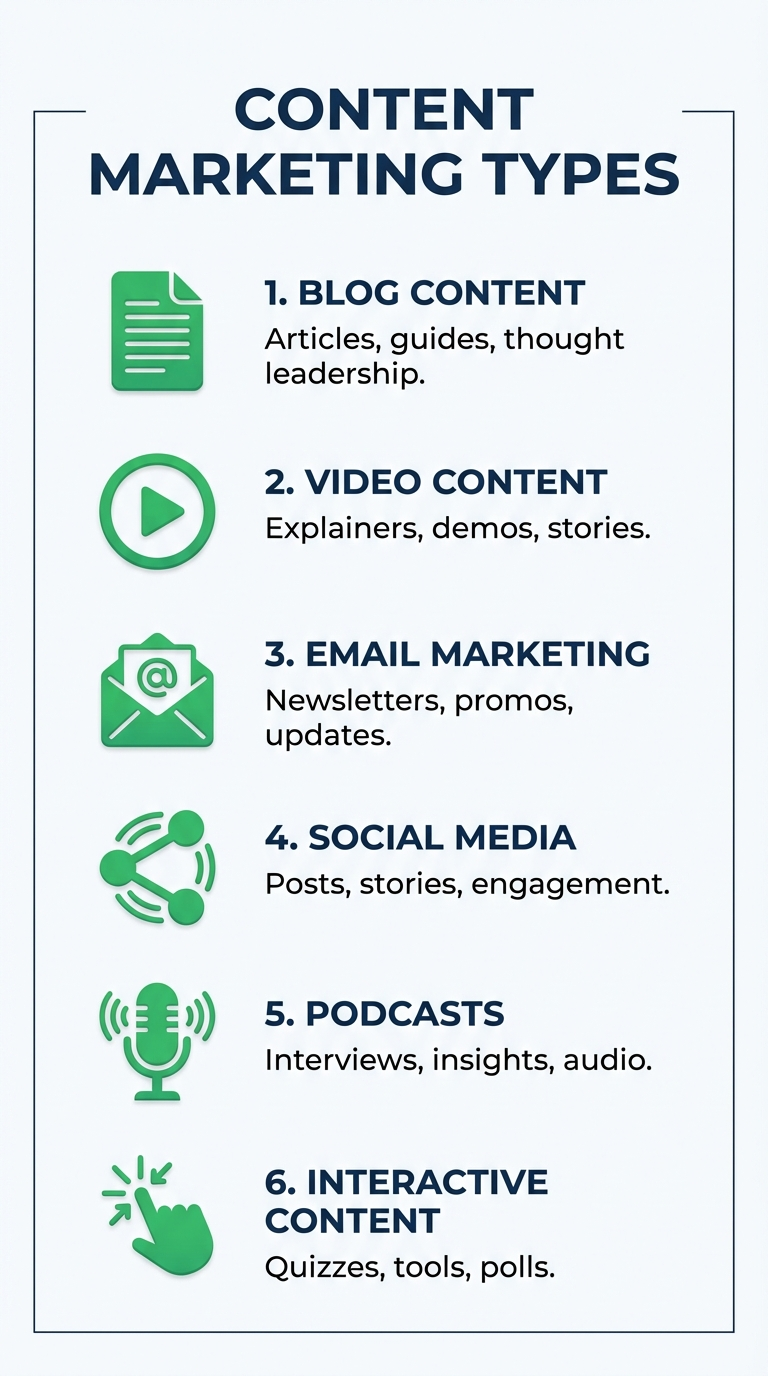
Types of Content Marketing
Effective content marketing utilizes multiple formats to reach audiences where they prefer to consume information.
Blog Content
Blogging remains the foundation of most content marketing strategies. Well-optimized blog posts attract organic traffic, establish expertise, and provide shareable resources for social media and email marketing.
Effective blog content types include:
- How-to guides: Step-by-step instructions solving specific problems
- Industry insights: Analysis and commentary on trends
- Listicles: Curated collections of tips, tools, or resources
- Case studies: Real-world examples demonstrating results
- Ultimate guides: Comprehensive resources covering topics in depth
Plan your blog strategy with our content calendar guide.
Video Content
Video has become the dominant content format online. By 2026, videos comprise over 80% of all global internet traffic, and short-form video delivers the highest ROI of any content format at 21%.
Video content opportunities include:
- Explainer videos: Simplify complex concepts visually
- Product demonstrations: Show your offering in action
- Customer testimonials: Build credibility through social proof
- Behind-the-scenes: Humanize your brand
- Short-form content: Reels, TikToks, and YouTube Shorts for engagement
Learn more about optimizing video for search in our YouTube SEO guide.
Email Marketing
Email marketing remains one of the highest-ROI content channels available. Newsletters, automated sequences, and targeted campaigns nurture leads and maintain customer relationships.
According to HubSpot, 95% of marketers using generative AI for email creation rate it “effective,” highlighting how AI is enhancing email content performance.
Social Media Content
Social media marketing amplifies your content reach and enables direct audience engagement. Each platform requires adapted content—what works on LinkedIn differs from Instagram or TikTok.
Podcasts and Audio
Audio content continues growing as audiences multitask during commutes, workouts, and daily activities. Podcasts build deep audience relationships through long-form, conversational content.
Interactive Content
Calculators, quizzes, assessments, and interactive tools drive engagement and generate leads while providing immediate value to users.
Content Marketing and AI in 2026

Artificial intelligence has transformed content marketing workflows. 89% of small business owners and marketers now use AI for content marketing and SEO, with 68% reporting higher content marketing ROI as a result.
AI applications in content marketing include:
- Content ideation: Generating topic ideas and outlines
- First drafts: Creating initial content for human refinement
- SEO optimization: Identifying keywords and optimization opportunities
- Personalization: Tailoring content to audience segments
- Performance analysis: Extracting insights from content data
Explore how AI-powered strategies can enhance your content marketing.
AI doesn’t replace human creativity—it amplifies it. The most effective content combines AI efficiency with human insight, emotion, and strategic thinking.
What Does a Content Marketer Do?
Content marketers wear many hats, combining creative and analytical skills to drive results. Core responsibilities include:
Strategy Development
Content marketers develop comprehensive strategies aligned with business objectives. This involves audience research, competitive analysis, channel selection, and content planning.
Content Creation
Writing, designing, filming, or coordinating the production of content across formats. Strong content marketers either create directly or manage teams and freelancers who do.
Distribution and Promotion
Creating great content isn’t enough—it needs to reach its audience. Content marketers manage publishing schedules, social promotion, email distribution, and paid amplification.
Performance Analysis
Measuring what works and what doesn’t through analytics. Content marketers track KPIs like traffic, engagement, conversions, and ROI to continuously improve results.
Learn about essential metrics in our digital marketing KPIs guide.
Building a Content Marketing Strategy
Effective content marketing requires strategic planning, not random acts of content creation.
1. Define Your Goals
What do you want content marketing to achieve? Common objectives include:
- Increasing brand awareness
- Generating qualified leads
- Supporting sales enablement
- Improving customer retention
- Establishing thought leadership
2. Know Your Audience
Develop detailed buyer personas documenting who your ideal customers are, what challenges they face, where they consume content, and what information they need at each buying stage.
3. Audit Existing Content
Inventory what you already have. Identify top performers to replicate, gaps to fill, and underperforming content to update or remove.
4. Plan Your Content Mix
Determine what types of content you’ll create, how often you’ll publish, and which channels you’ll prioritize based on your audience and resources.
5. Create a Content Calendar
Map out your content schedule weeks or months in advance. Include topics, formats, authors, publish dates, and promotion plans.
6. Establish Workflows
Document processes for content creation, review, approval, and publishing. Clear workflows ensure consistent quality and timely delivery.
7. Measure and Optimize
Track performance against your goals. Double down on what works, adjust what doesn’t, and continuously test new approaches.
Content Marketing ROI: Measuring Success
With 54% of marketers now measuring content marketing ROI, accountability has become essential. Key metrics to track include:
- Traffic metrics: Pageviews, unique visitors, time on page
- Engagement metrics: Social shares, comments, email opens
- Lead metrics: Form submissions, email signups, content downloads
- Revenue metrics: Attributed sales, customer acquisition cost, lifetime value
Common Content Marketing Mistakes
Avoid these pitfalls that undermine content marketing effectiveness:
- Creating without strategy: Random content produces random results
- Focusing only on quantity: Quality trumps volume every time
- Ignoring SEO: Great content nobody finds helps nobody
- Inconsistent publishing: Sporadic efforts don’t build momentum
- Not promoting content: Publishing is just the beginning
- Skipping measurement: You can’t improve what you don’t track
Content Marketing for Philippine Businesses
For businesses targeting the Philippine market, content marketing offers particular advantages:
- High digital engagement: Filipinos spend over 9 hours daily online on average
- Social media adoption: Among the world’s highest social media usage rates
- Growing e-commerce: Rapid online shopping growth creates content opportunities
- English proficiency: Access to global content resources and audiences
Localize your content strategy by understanding Philippine consumer behavior, cultural nuances, and platform preferences. What resonates in Metro Manila may differ from provincial markets.
Working with a Content Marketing Agency
Many businesses partner with content marketing agencies to accelerate results. Agency partnerships provide:
- Strategic expertise and fresh perspectives
- Access to skilled writers, designers, and videographers
- Established processes and tools
- Scalable content production capacity
- Objective performance analysis
Truelogic has been helping Philippine businesses build effective content marketing strategies since 2009. Contact us to discuss how we can help grow your business through strategic content.
The Future of Content Marketing
Several trends are shaping content marketing’s evolution:
AI-Augmented Creation
AI will increasingly handle routine content tasks, freeing human creators to focus on strategy, creativity, and emotional resonance. Successful content marketers will learn to leverage AI as a powerful tool rather than resist it.
Personalization at Scale
Dynamic content that adapts to individual users based on their behavior, preferences, and journey stage will become standard. Generic one-size-fits-all content will underperform compared to personalized experiences.
Interactive and Immersive Formats
Beyond passive consumption, content will increasingly invite participation. Interactive tools, AR/VR experiences, and gamified content create deeper engagement than static formats.
Voice and Audio Growth
As voice search and smart speakers proliferate, optimizing content for audio consumption becomes increasingly important. Podcasts and audio content will continue gaining share of attention.
Community-Driven Content
Brands that build engaged communities around their content create sustainable advantages. User-generated content, community discussions, and collaborative creation foster loyalty that paid advertising cannot match.
Getting Started with Content Marketing
Whether you’re launching a content marketing program or improving an existing one, start with these fundamentals:
- Define success: Set clear, measurable objectives
- Know your audience: Research deeply before creating
- Start focused: Master one channel before expanding
- Commit to consistency: Regular publishing builds momentum
- Measure everything: Let data guide your decisions
- Iterate continuously: Improve based on what you learn
Content marketing success doesn’t happen overnight. It requires sustained effort, strategic thinking, and willingness to adapt. But for businesses willing to invest in creating genuine value for their audiences, the rewards—in traffic, leads, and customer loyalty—are substantial and compounding.