Fundamentals of Marketing: What You Need to Know

Marketing fundamentals are the structural variables (product, price, place, promotion, audience segmentation, and positioning) that determine whether a brand’s message reaches the right buyers and converts attention into revenue. Businesses that invest in strong marketing foundations are 13 times more likely to achieve positive ROI, and those prioritizing marketing grow revenue 2 to 3 times faster than those that don’t.
TL;DR: Marketing rests on three interlocking systems: the STP engine (segmentation, targeting, positioning) that identifies your audience, the 4 Ps framework (product, price, place, promotion) that shapes your offer, and four first principles (customers differ, customers change, competitors react, resources are limited) that constrain every strategic decision you’ll make.
How Marketing Fundamentals Were Defined
Professor E. Jerome McCarthy introduced the four Ps framework (product, price, place, and promotion) in “Basic Marketing: A Managerial Approach” in 1960. Before McCarthy, marketing theory was scattered across economics, psychology, and sales management textbooks with no unifying structure. His contribution was compression: four variables that any business, regardless of size or industry, could manipulate to influence buyer behavior.
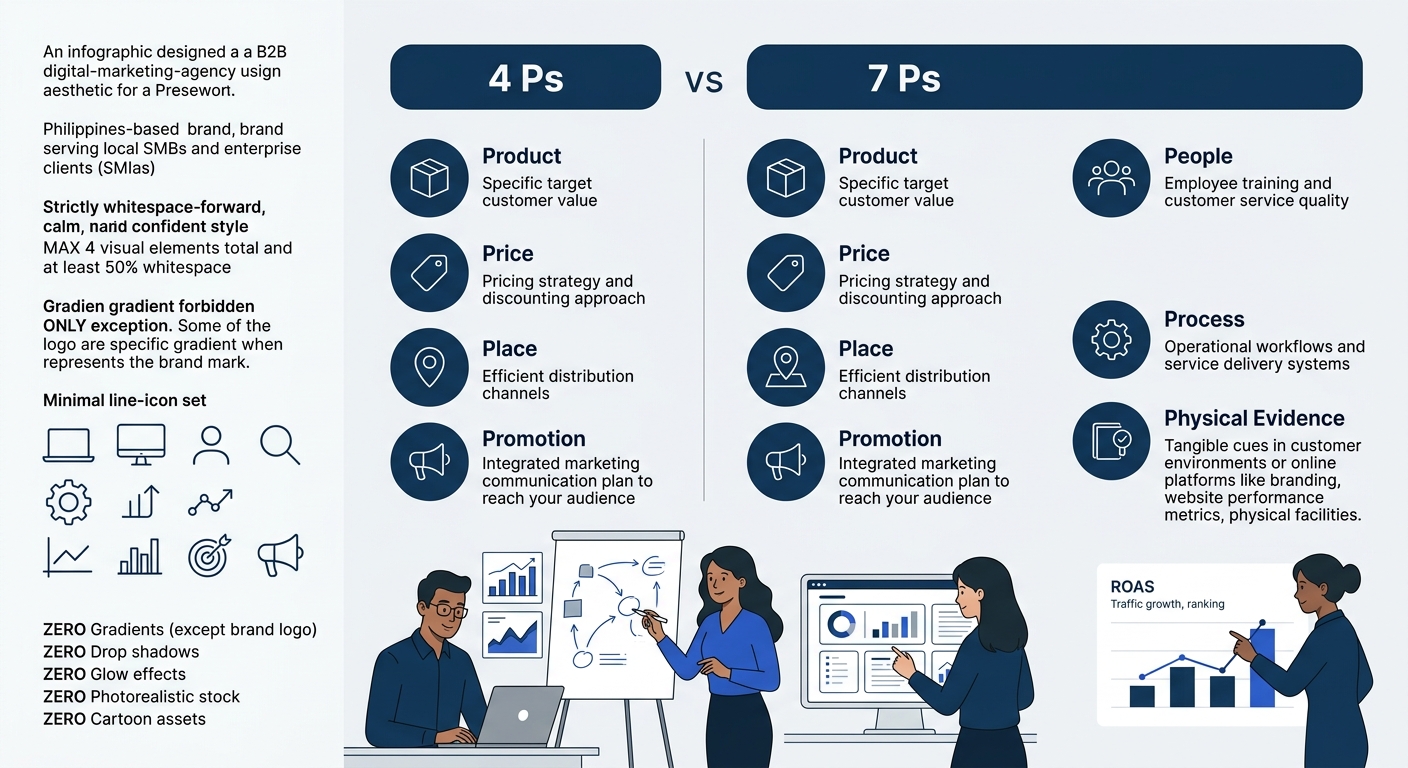
The framework later expanded. The 7 Ps model added People, Process, and Physical Evidence to account for service-based industries where the customer experience extends well beyond the physical product. As VistaPrint’s marketing principles overview puts it, these seven elements help businesses “define their product, set pricing, choose distribution channels, promote their brand and create a consistent customer experience.” The operative word in that definition is “consistent.” Each P reinforces or undermines the others.
But the Ps describe tactical levers. The strategic engine underneath them is a different tripod entirely: segmentation, targeting, and positioning (STP). EBSCO Research identifies these three concepts as the basis of all business marketing strategy, preceding and informing every tactical decision about which levers to pull and how far.
Understanding how these systems connect is what separates a functional marketing operation from a collection of disconnected campaigns.
Segmentation, Targeting, and Positioning
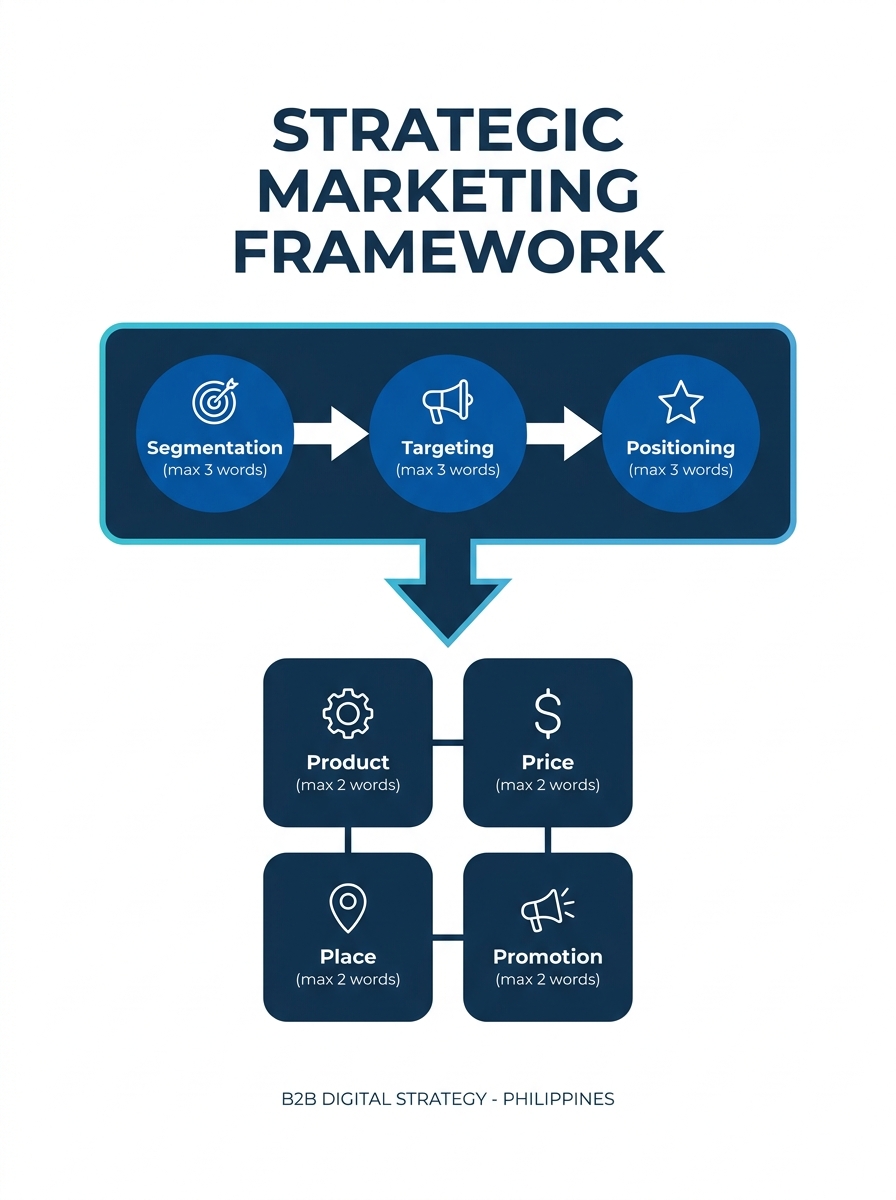
STP is the strategic engine that runs before any creative brief gets written or any media gets bought. Segmentation divides a total addressable market into distinct groups based on shared characteristics: demographics, behaviors, needs, geography, psychographics. Targeting evaluates which of those segments a brand can serve profitably. Positioning defines how the brand will occupy a distinct place in the minds of that target segment relative to competitors.
The sequence matters. A brand that skips segmentation and jumps straight to promotion is spending money talking to people who were never going to buy. This is a pattern we see frequently in the Philippine market, where brands default to broad-reach campaigns on Facebook or TikTok without first defining which audience clusters generate the highest lifetime value.
For companies running ecommerce digital marketing services, STP work determines which product categories get priority ad spend, which customer cohorts receive retention campaigns, and which price points get tested first. Without it, every downstream marketing dollar carries unnecessary risk.
Research on the first principles of marketing strategy, published in the Journal of the Academy of Marketing Science, grounds this in four assumptions: (1) all customers differ, (2) all customers change, (3) all competitors react, and (4) all resources are limited. STP is the mechanism that operationalizes the first assumption directly. If all customers differed in the same predictable ways, segmentation wouldn’t be necessary. They don’t, so it is.
The 4 Ps and What Each One Controls
Each of the four Ps governs a different lever in the marketing system. They work in concert, and changing one creates pressure on the others.
Product is the tangible item or service being sold. The fundamental question is whether it addresses the needs, wants, and expectations of the target segment identified through STP work. A product built for a segment the brand hasn’t validated is a product built on assumptions. Content marketing generates three times more leads than traditional advertising, but only when the content is anchored to a product that solves a real problem for a defined audience.
Price determines perceived value and competitive position simultaneously. Pricing strategy options range from penetration pricing (entering the market at a low price to capture share quickly) to price skimming (launching high and reducing over time as competition enters). Getting pricing wrong doesn’t affect revenue alone; it repositions the brand in ways that are expensive to reverse. Brand-loyal customers commit to a brand without respect to price, according to Investopedia’s coverage of marketing essentials, but building that loyalty requires consistent delivery across every other P first.
Place refers to distribution channels: where and how customers can access the product. For Philippine brands, this increasingly means an omnichannel approach where physical retail, marketplace listings (Shopee, Lazada), owned ecommerce, and social commerce operate as a unified system. Brands that treat each channel as an independent silo lose attribution visibility and duplicate costs.
Promotion covers communication: advertising, PR, content, sales promotion, personal selling, and digital channels. This is where most marketing budgets concentrate, and where the largest misallocations happen when the upstream STP work is weak. A managed PPC program targeting the wrong segments will burn through budget efficiently but unproductively.
A brand that skips segmentation and jumps straight to promotion is spending money talking to people who were never going to buy.
The Expanded 7 Ps and Why Services Need More Variables
The original 4 Ps assumed a product-centric economy. When services became the dominant sector globally, three additional variables entered the framework to capture dimensions the original model missed.
People accounts for the human element: the staff who deliver the service, the culture of the organization that shapes customer interactions, and the training systems that maintain quality. For marketing agencies, “People” is arguably the primary differentiator. Two agencies can run identical Google Ads campaigns with the same targeting parameters, and the one with stronger strategic operators will outperform consistently.
Process is the system through which the service gets delivered. In a marketing context, this includes everything from client onboarding workflows to campaign approval chains to reporting cadences. When brands evaluate agency partners, they’re evaluating process maturity whether they realize it or not. A web design agency that delivers strong wireframes but has no revision workflow or QA process will produce inconsistent results across projects.
Physical Evidence covers the tangible proof that the service was delivered and delivered well. Case studies, portfolio pages, client testimonials, professional website design, and even the formatting of a strategy deck all function as physical evidence. Research shows 77% of consumers prefer brands they recognize and trust, making physical evidence a critical trust signal for service businesses competing in crowded Philippine markets against lower-cost alternatives.
The 7 Ps framework gives brands a more complete picture of the levers available to them. But the keyword in any valid definition of the framework is “consistent.” Each P reinforces or undermines the others, and excellence in one area (say, Promotion) can’t compensate for fundamental weakness in another (say, Process).
How the Parts Connect Into a Working System
The marketing fundamentals described above aren’t a checklist you work through once during annual planning and then archive. They form a feedback loop where market data continuously refines each variable.
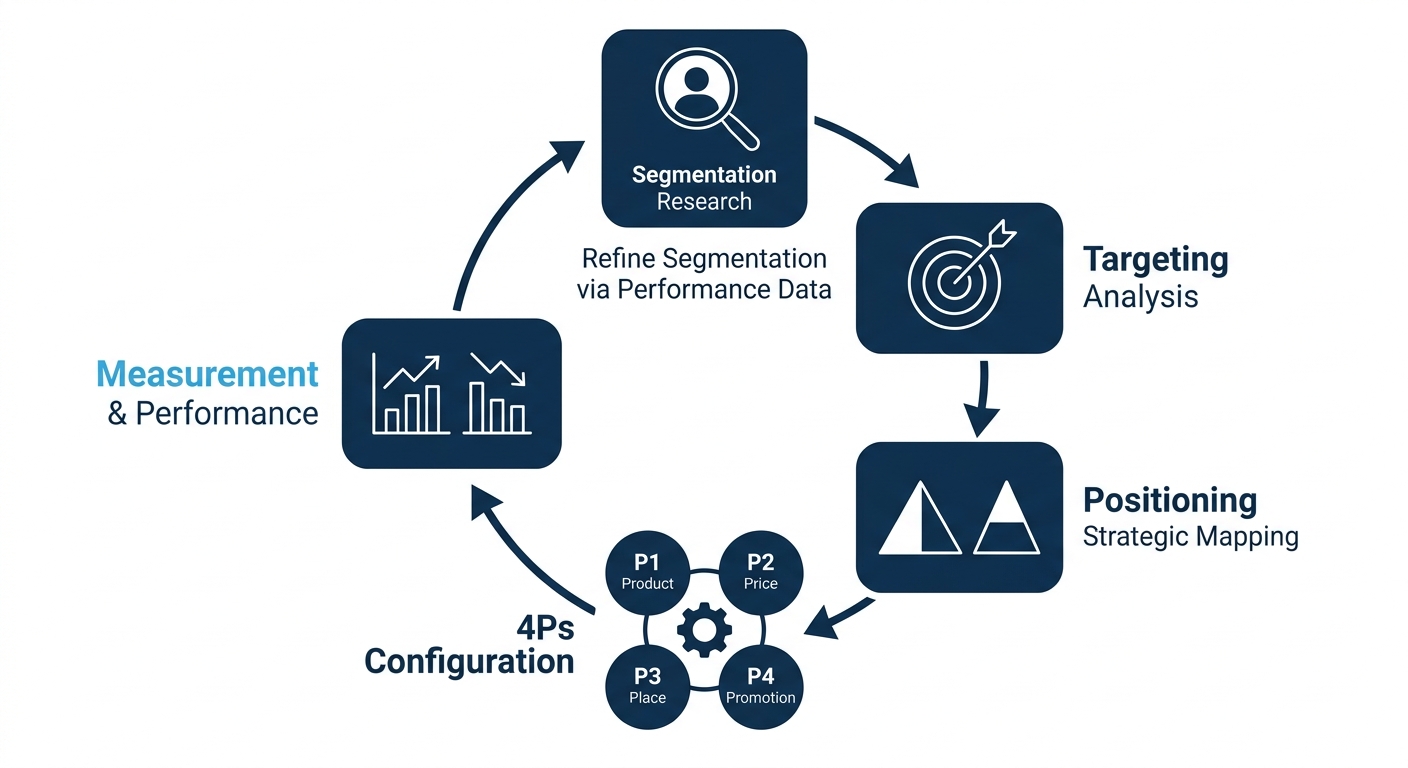
Here’s how the loop typically runs inside a well-functioning marketing organization:
- Segmentation research identifies three to five viable audience clusters with distinct needs, price sensitivity, and channel preferences.
- Targeting analysis selects one to three segments based on addressable market size, competitive density, and margin potential.
- Positioning work defines the brand’s distinct claim for each target segment, usually captured in a positioning statement that maps to a specific competitive gap.
- 4 Ps configuration translates that positioning into product features, pricing tiers, distribution strategy, and promotional messaging.
- Measurement and iteration feeds performance data back into segmentation assumptions, testing whether the original clusters still hold.
Email marketing delivers an average ROI of $36 for every $1 spent, but that number assumes the segmentation upstream is sound. Send the same email to an unsegmented list and the return collapses. Brands that treat analytics as a core discipline rather than an afterthought can identify when specific segments are drifting or when a pricing decision is eroding positioning.
This is also where many Philippine enterprises struggle. The marketing team builds a campaign, the campaign runs, results come in, but no one closes the loop by feeding those results back into STP assumptions. The information architecture of a brand’s digital presence often reflects this disconnect: product pages built for one audience, blog content targeting another, and paid media reaching a third.
Where the Framework Breaks Down
The 4 Ps and STP model assume relatively rational markets and stable competitive dynamics. Several real-world conditions break those assumptions.
Category disruption invalidates positioning overnight. When a new entrant redefines what the category means (think of how grab-and-go food delivery reshaped restaurant marketing across Southeast Asia), the positioning work done against the old competitive set becomes irrelevant. The first-principles framework accounts for this with its third assumption (all competitors react), but the speed of reaction required often exceeds the planning cycle of most marketing teams.
Data-poor environments cripple segmentation. STP requires data about customer differences. Brands operating in markets where purchase behavior isn’t tracked digitally, where CRM adoption is low, or where privacy regulations limit data collection are working with incomplete inputs. The segments they construct may reflect organizational assumptions rather than actual buyer behavior.
Channel fragmentation dilutes “Place.” The original framework assumed a manageable number of distribution channels. A Philippine brand selling through Shopee, Lazada, TikTok Shop, its own website, Instagram DMs, and three physical retail locations faces a “Place” variable with so many dimensions that optimizing across all of them simultaneously requires infrastructure most mid-market companies don’t have. As research on multi-location marketing complexity shows, 61% of CMOs report infrastructure gaps that block ROI measurement across channels.
The model says nothing about timing. When to launch, when to raise prices, when to pull back on promotion. The Ps are structural variables, not temporal ones. Brands that treat them as static configurations rather than dynamic settings that shift quarterly with market conditions will find their marketing strategy aging faster than competitors can exploit.
Info: The fundamental frameworks remain the best available starting point for structuring marketing decisions. Their value lies in providing a shared vocabulary and a systematic way to audit where a brand’s strategy has gaps. The limitations above don’t invalidate the model; they define the conditions under which the model needs supplemental tools and faster iteration cycles.
Common Questions
Are the 4 Ps still relevant, or have they been replaced?
The 4 Ps remain the dominant framework for product-centric businesses. The expanded 7 Ps model better serves service industries and experience-driven brands. Neither has been “replaced.” Academic marketing strategy research continues to build on McCarthy’s 1960 framework while acknowledging its limitations in digital, platform-mediated, and AI-influenced markets.
What’s the difference between marketing fundamentals and a marketing strategy?
Marketing fundamentals are the structural variables (STP, the Ps) that define the playing field. A marketing strategy is the specific plan a brand builds using those variables to achieve a business objective within a defined timeframe. Fundamentals are the grammar; strategy is the sentence you write with it. Brands that struggle with strategy often have a fundamentals problem they haven’t diagnosed.
Which marketing fundamental matters most for Philippine businesses?
Segmentation. The Philippine market’s demographic diversity (age distribution, income stratification, geographic fragmentation across 7,000+ islands, and wide variance in digital adoption) makes undifferentiated mass marketing the most expensive mistake a brand can make. Brands that segment precisely spend less per acquisition, build stronger positioning, and get more signal from performance data. An investment in audience research compounds across every other marketing decision that follows it.
Do digital-first businesses need to think about “Place”?
Yes, but “Place” means something different for them. For a digital-first brand, Place encompasses platform selection (Shopee vs. owned ecommerce vs. social commerce), marketplace algorithm dynamics, SEO visibility as a discovery channel, and the brand’s discoverability through AI-mediated search. The core question is the same one McCarthy asked in 1960: where does the customer encounter the product? The answer now involves more variables and faster shifts between channels.
How often should a company revisit its marketing fundamentals?
At minimum, annually during strategic planning. In practice, STP assumptions should be pressure-tested quarterly using actual performance data. Pricing, channel mix, and promotional strategy should flex with market conditions throughout the year. The first-principles research emphasizes that all customers change, which means the segmentation that was accurate twelve months ago may already be describing a market that no longer exists.