PPC vs. Organic Search: Building a Unified Attribution Model That Actually Shows ROI for Philippine Enterprises
Google Ads’ default reporting assigns all conversion credit to the last click before a sale. For most Philippine enterprise accounts we’ve audited, that single setting inflates paid search’s apparent contribution by roughly twenty percentage points, according to cross-channel attribution research from Symphonic Digital. The organic blog post that introduced the brand, the retargeting impression that kept it top of mind, the email that brought the buyer back — all of it gets erased. And the budget meeting that follows tells a story where paid search is the hero and everything else is overhead. If you’re a CMO or VP of marketing at a Philippine enterprise allocating eight figures of media spend across channels, that distortion shapes real decisions: where next quarter’s budget goes, which teams grow, and which programs get cut.
The problem here is structural. It lives in the conversion attribution framework your agency and your internal team are using. And fixing it requires more than switching a toggle in GA4.
Why Last-Click Attribution Punishes Your Best-Performing Channels
The appeal of last-click is obvious. It’s simple, it’s the default in Google Ads, and it produces clean reports. One conversion, one source, one line item. But simplicity comes at a cost. A paid ad someone clicked five minutes before signing a contract gets full credit for a deal that took weeks of organic touchpoints to nurture. The content marketing team can feel the pipeline moving, but their tools tell a different story.
This dynamic is especially pronounced in the Philippines, where enterprise purchase cycles for financial services, real estate, insurance, and B2B technology tend to stretch across multiple weeks and involve several decision-makers. A Metrobank prospect doesn’t see one ad and open an account. They search a question, land on an organic article, click away, see a display ad three days later, come back through a branded search, and finally convert through a PPC ad for a specific product. Under last-click, PPC gets everything. Under reality, PPC closed a deal that organic search initiated and display kept alive.
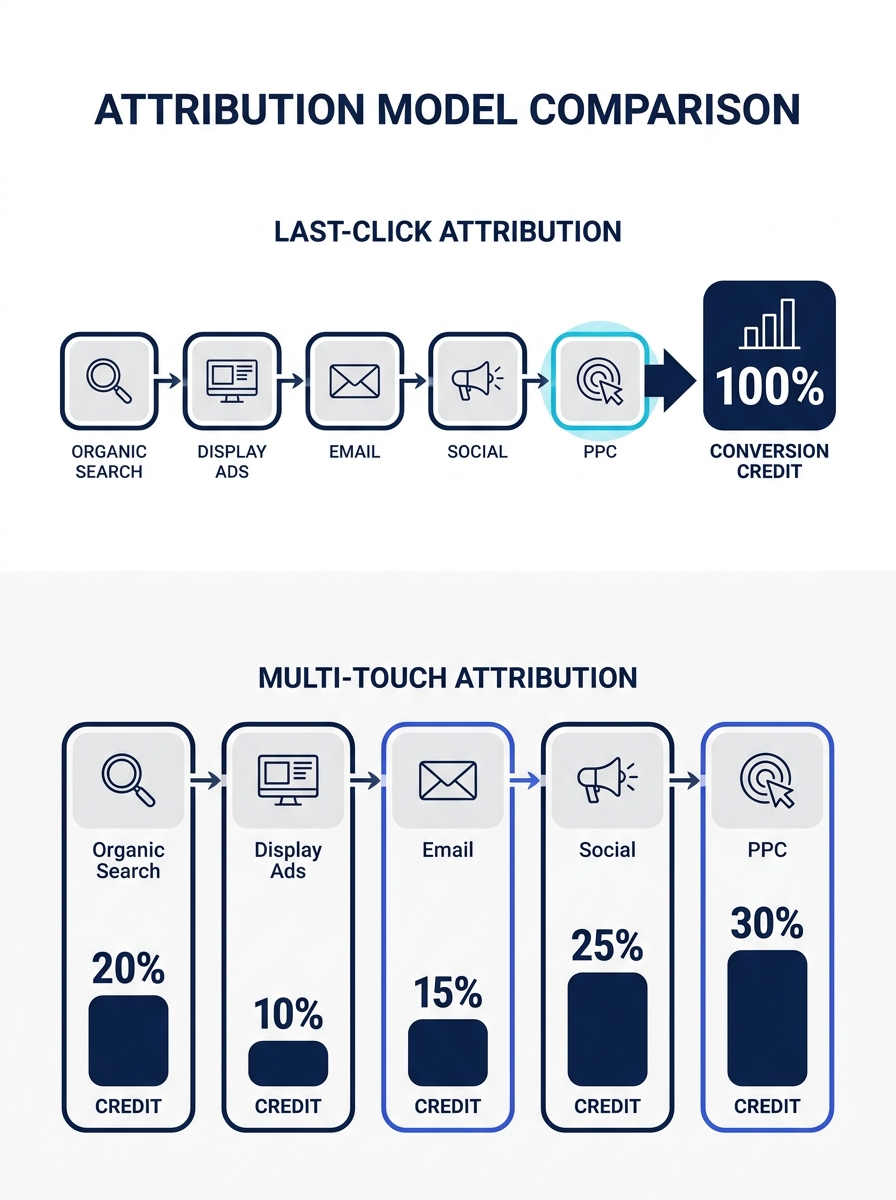
The damage compounds over time. When organic search and content marketing can’t demonstrate revenue contribution, their budgets shrink. When PPC gets all the credit, its budget grows — even when the incremental return on that additional spend is declining. We’ve seen this pattern in enterprise accounts across banking, insurance, and property development in the Philippines. The paid media team looks like it’s carrying the business while the organic team struggles to justify headcount. The measurement system, not the performance, created that gap.
And this gets harder to untangle as privacy restrictions tighten. As SegmentStream’s analysis of enterprise attribution platforms noted, enterprise teams now face limited user-level tracking and increasing reliance on modeled outcomes. Cookie deprecation, iOS privacy changes, and consent-based tracking mean that the data feeding your attribution model is already incomplete. Layering last-click logic on top of incomplete data produces conclusions that are confidently wrong.
What a Unified Attribution Model Requires
A unified attribution model connects PPC and organic search data into a single view of the customer path, distributing credit across every meaningful touchpoint. The concept sounds straightforward. The execution is where Philippine enterprises consistently get stuck.
The first prerequisite is shared measurement infrastructure. Your Google Ads data, GA4 organic data, CRM conversion data, and offline sales data need to flow into one place. For many Philippine enterprises running Salesforce or HubSpot alongside Google’s ecosystem, this means configuring server-side tagging, CRM integration, and consent-mode tracking simultaneously. If your agency manages paid media and a separate team manages SEO, the data often lives in separate dashboards with separate definitions of what counts as a conversion. Unifying the model starts with unifying the data layer, and we’ve written about how an SEO dashboard that predicts revenue depends on exactly this kind of plumbing.
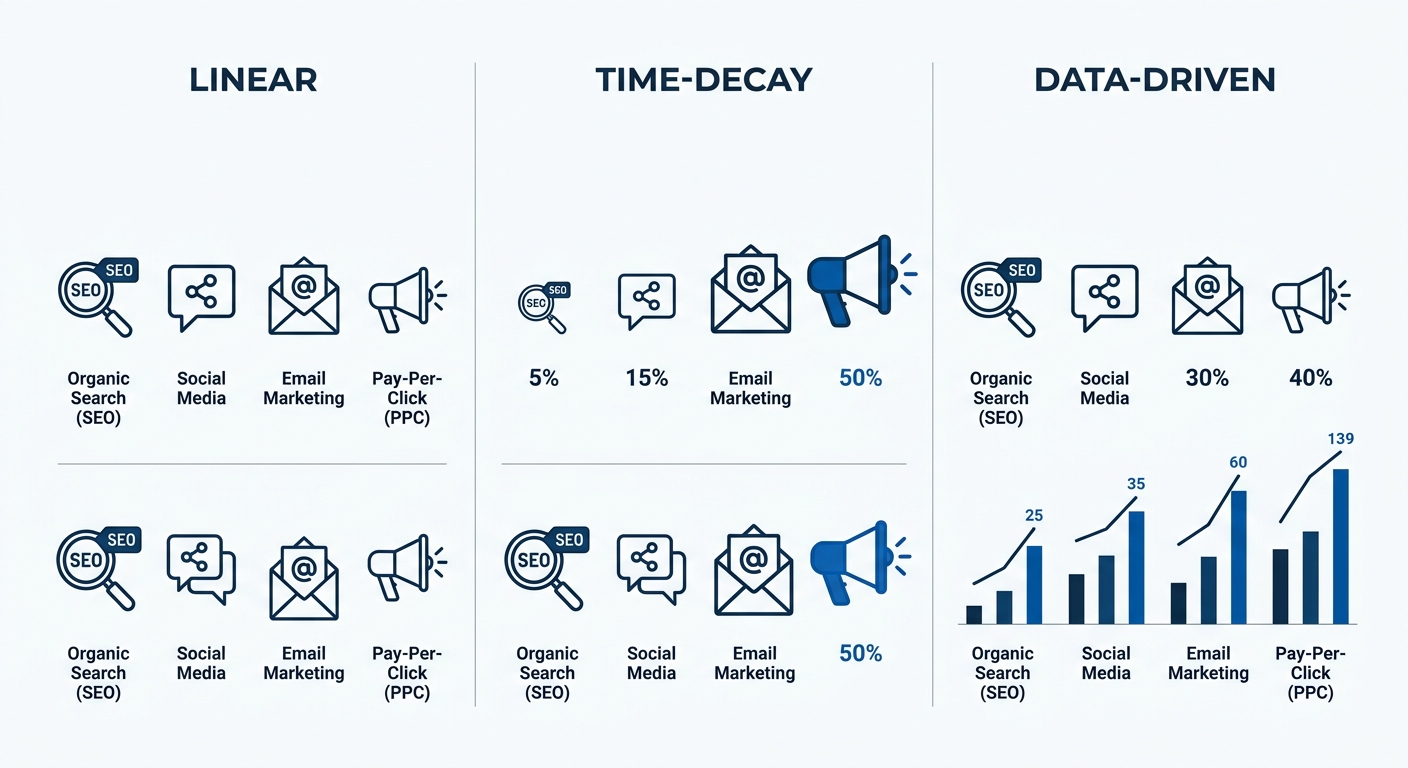
The second prerequisite is choosing an attribution model that reflects your actual sales cycle. GA4 offers several options within its attribution paths report. Linear attribution gives equal weight to every touchpoint — transparent but blunt. Time-decay attribution weights touchpoints closer to conversion more heavily, which works better for longer sales cycles but can undervalue the early awareness content that brought the prospect into your orbit in the first place. Data-driven attribution, GA4’s default since it replaced last-click, uses machine learning to assign credit based on observed patterns in your specific account. For Philippine enterprises with enough conversion volume to train the model, data-driven is typically the strongest starting point.
But choosing a model is the easier part. The harder work is organizational. Multi-touch attribution in the Philippines — or anywhere — forces a conversation that most marketing departments avoid: the conversation about shared credit. When organic and paid both contributed to a conversion, who “owns” it? Agencies that manage both channels can resolve this internally. But when separate vendors handle SEO and PPC, the incentive structure works against honest attribution. Each vendor wants to maximize the credit their channel receives, because that credit justifies their retainer. If you’re a Philippine enterprise evaluating your agency setup, ask directly: does your conversion attribution framework give shared credit, or does each channel report in isolation? The answer tells you whether your attribution model is unified or just two single-channel reports stapled together.
The measurement system, not the performance, created the gap between how paid and organic teams are perceived.
Where PPC and Organic Revenue Tracking Actually Overlap
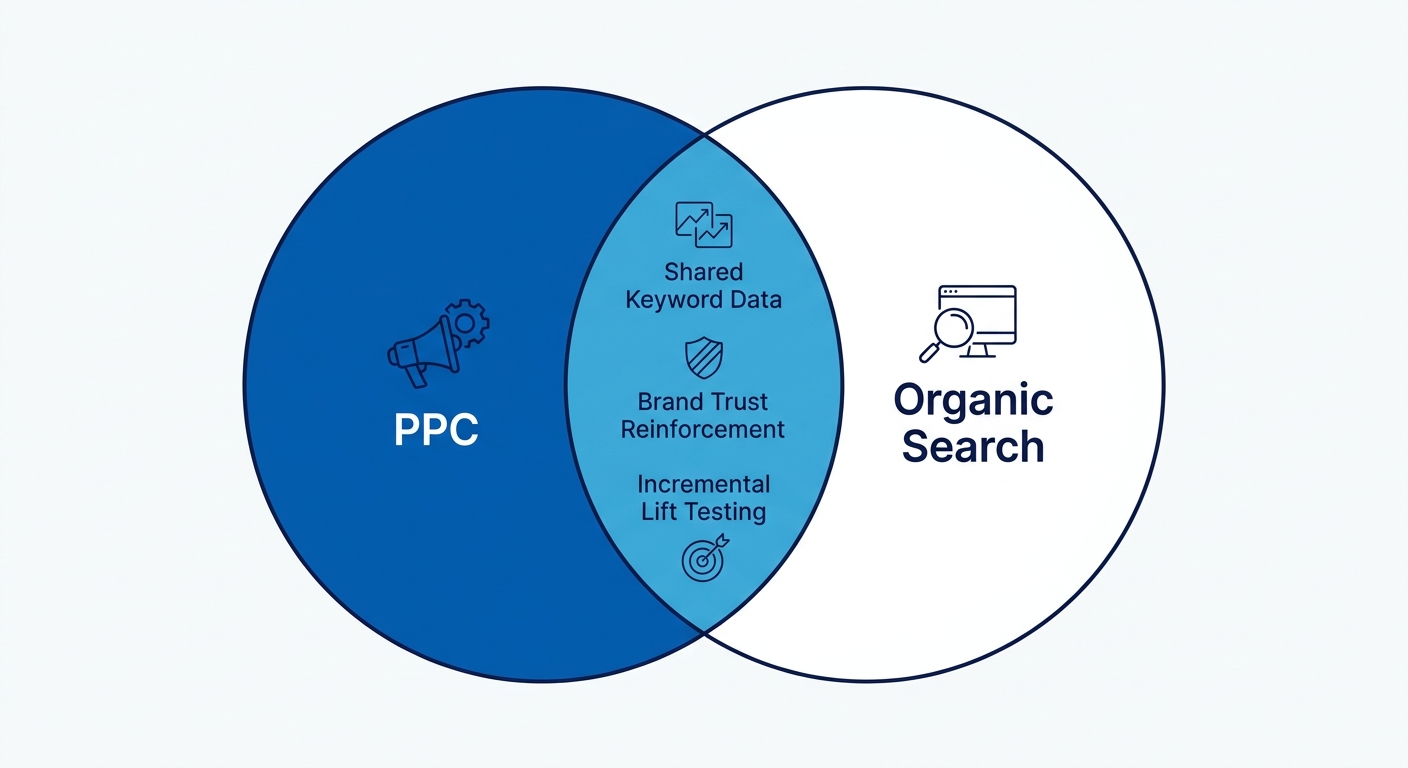
The relationship between paid and organic search is more tangled than most reports suggest. When both a PPC ad and an organic listing appear for the same query, the interaction effects are significant. Research indicates that when organic rankings sit in the top three positions, organic captures the vast majority of clicks for that query. But running PPC alongside strong organic rankings still lifts total click volume, because the dual presence reinforces brand trust. The question for Philippine enterprises isn’t whether to run both — it’s how to measure whether the PPC spend on queries where you already rank organically is delivering incremental value or cannibalizing clicks you’d have gotten for free.
This is where organic vs paid revenue tracking gets practical. Run a controlled test: pause branded PPC for a defined period in a specific geography (say, Cebu or Davao) and measure what happens to organic traffic and conversions for those same branded terms. In most cases, organic traffic will rise but won’t fully compensate for the lost paid clicks. The gap tells you the true incremental value of your branded PPC spend. That gap — not the raw conversion count from Google Ads — is what belongs in your ROI calculation.
For non-branded terms, the dynamic is different. PPC delivers results within hours, making it ideal for testing keyword viability before committing to the months-long investment of organic content development. If a keyword converts well through paid ads, that’s a strong signal to build organic content around it. If it doesn’t convert even with precise ad copy and landing pages, the organic team can deprioritize it. This feedback loop between paid and organic is one of the clearest advantages of a unified approach to PPC and SEO ROI, and it’s something we see consistently underused in Philippine enterprise accounts where the two channels operate in silos.
The way we frame this for clients is straightforward: PPC is your laboratory; organic is your long-term asset. The laboratory tells you which experiments are worth scaling into permanent infrastructure. But the laboratory’s reports are only useful if the measurement system can track a prospect from their first organic visit through their eventual paid click and all the way to revenue in your CRM. That’s the full picture. Anything less gives you fragments, and fragments lead to bad budget decisions.
This connects directly to a broader point we’ve made about reframing SEO from traffic goals to revenue goals. When organic search is measured only by sessions and rankings, it can never compete with PPC’s clean revenue attribution. The fix is to measure organic the same way you measure paid: by tracking the revenue path from first touch to closed deal. A unified attribution model makes that possible. Without it, you’re comparing a channel that reports revenue (PPC) against a channel that reports traffic (organic), and the revenue channel will always win that budget argument.
Info: If your agency reports PPC results in revenue and SEO results in traffic, you don’t have a unified attribution model. You have two separate scorecards using different units of measurement.
The Uncomfortable Uncertainty in Any Attribution Model
Even a well-built multi-touch attribution model is an approximation. It distributes credit according to rules — whether those rules are human-defined (linear, time-decay) or machine-learned (data-driven). None of them capture the full truth of why a customer decided to buy. The prospect who read your organic article on a Tuesday morning and thought about it for three days before searching your brand name and clicking a PPC ad — what actually drove that conversion? The content? The ad? The three days of subconscious consideration? No model captures cognition. They capture clicks and timestamps.
This matters because Philippine enterprises sometimes delay building a unified attribution model while searching for a perfect one. There’s a tendency to ask “which model is correct?” when the better question is “which model is least wrong for our sales cycle?” For high-consideration B2B services with month-long pipelines, time-decay or data-driven models consistently produce more useful signals than last-click. For e-commerce with shorter cycles, even a simple position-based model (which credits the first and last touches most heavily) gives a meaningfully better picture than the default.
The practical recommendation we give to enterprise clients is to start with GA4’s data-driven attribution as your baseline, ensure your technical SEO and site measurement infrastructure are properly configured, and then layer CRM data on top to close the gap between online touchpoints and offline revenue. You won’t capture everything. Some conversions will remain ambiguous. But a model that’s eighty percent accurate across both channels will produce dramatically better budget decisions than a model that’s precise about paid search and blind to everything else.
Attribution modeling is an act of structured humility. You’re admitting that no single channel deserves full credit, that the customer path is messier than any report can show, and that the best you can do is distribute credit in a way that reflects observed patterns rather than organizational politics. For Philippine enterprises spending across PPC and organic, that shift — from channel-level credit to path-level credit — is where the meaningful improvement in budget allocation actually starts. The model will always be imperfect. The decisions it enables will still be better than the ones you’re making without it.