Building Your Enterprise SEO Authority Map: A Step-by-Step Framework to Align Content with Revenue Goals

Enterprise keyword research conducted before mapping business capabilities produces content that ranks well and generates zero pipeline influence. The standard sequence — pull keyword volumes, group by topic, assign to writers — skips the structural layer that connects search visibility to the deals your sales team actually closes. Content-to-revenue alignment requires flipping that sequence entirely.
TL;DR: Enterprise SEO authority mapping starts from business capabilities, not keyword lists. Map what your company sells and how buyers evaluate it first. Then assign keyword clusters to those capabilities. The result is an SEO business capability framework where every piece of content traces back to revenue.
Why Keyword-First Planning Breaks at Enterprise Scale
The reason keyword-first SEO planning fails large organizations is structural: keyword tools surface demand signals, but they carry no information about which demand signals connect to high-value pipeline. Conductor’s database now indexes over 20 billion keywords, which means enterprise teams face a selection problem, not a discovery problem. The data is abundant. The filtering criteria are missing.
Consider the typical enterprise workflow. A team pulls 50,000 keyword opportunities across 12 product lines, groups them into clusters by semantic similarity, and starts publishing. Six months later, 70% of the resulting content targets informational queries that attract traffic from personas who will never buy. The pages rank. The dashboards look healthy. And the C-suite questions why organic search shows up as a cost center instead of a revenue channel.
As the enterprise SEO framework team at Piperocket Digital has documented, “traffic dashboards do not survive board meetings. Pipeline numbers do.” This gap between what SEO teams measure and what executives care about is where content programs stall, and where authority mapping becomes essential.
The disconnect intensifies when you’re running keyword research for B2B enterprises across multiple business units, each with its own product taxonomy, buyer persona set, and competitive landscape. Without a shared structural map underneath, keyword clusters collide. Two business units target overlapping terms. Internal pages compete against each other. The domain’s authority dilutes rather than compounds.
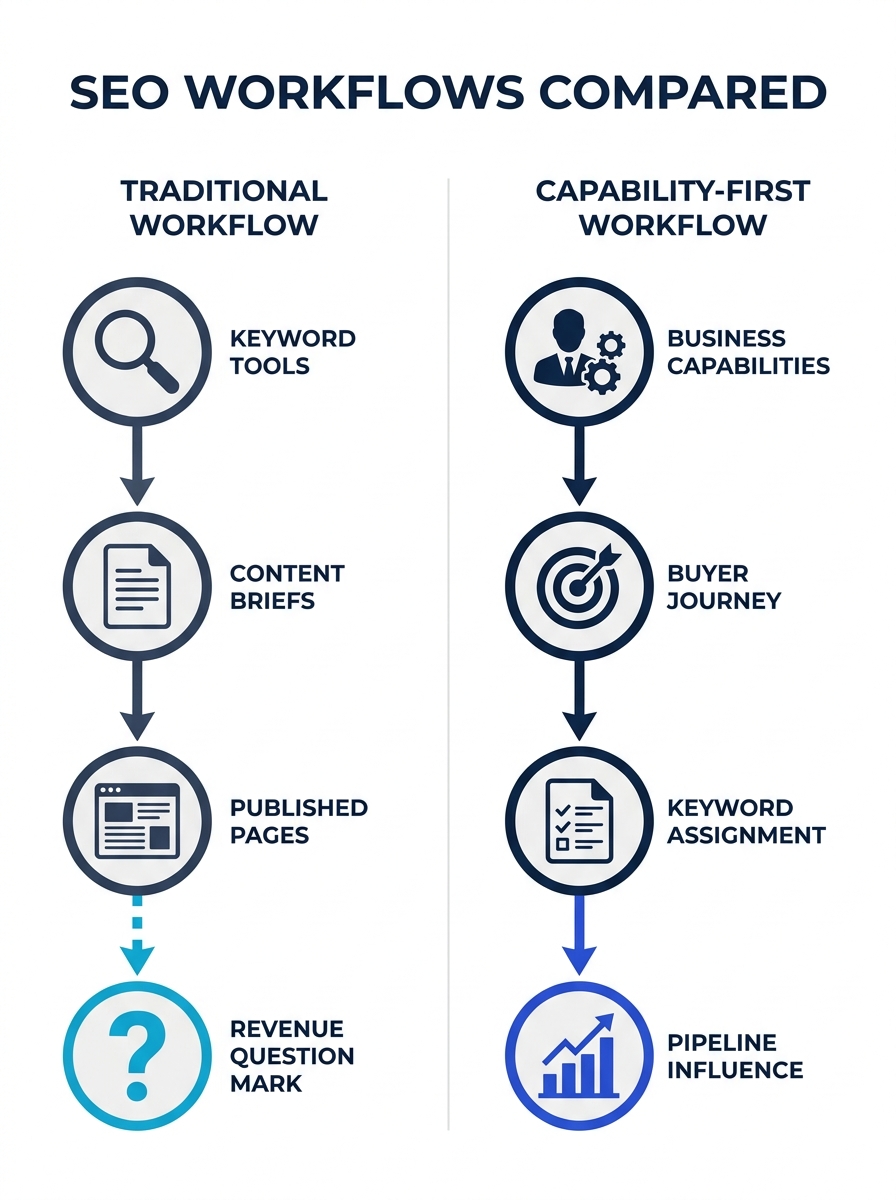
The Business Capability Layer That Keyword Tools Leave Out
Enterprise SEO authority mapping requires inserting a layer between your business strategy and your keyword research, and that layer is borrowed from enterprise architecture, not marketing. It’s called a business capability model.
Intuit’s enterprise strategy team defines a business capability model as a structured representation of what an organization does, grouped into operational, customer-facing, and strategic categories. In IT and operations planning, these models have been standard practice for decades. In SEO, they’re almost entirely absent. That absence explains why so many enterprise content programs produce impressive volume with weak commercial outcomes.
Here’s what an SEO business capability framework looks like in practice. Take a financial services company with four business units: retail banking, commercial lending, wealth management, and insurance. Each unit has distinct capabilities — account origination, risk assessment, portfolio construction, claims processing. Each capability maps to a specific buyer need, a specific stage in the buying cycle, and a specific set of keyword clusters that a human seeking to evaluate or purchase that capability would actually search.
The framework creates three mapping layers:
- Business capabilities — what the organization delivers, grouped by unit and buyer relevance
- Buyer evaluation criteria — how prospects assess each capability, the questions they need answered before they’ll engage sales
- Keyword clusters — the search language that corresponds to those evaluation questions
When your content team receives a brief, every piece traces back through all three layers. A blog post about treasury management automation isn’t chasing a high-volume keyword. It’s addressing the evaluation criteria for commercial lending’s cash management capability, targeting CFOs and treasurers who are 60 to 90 days from vendor shortlisting.
This is where content-to-revenue alignment stops being theoretical. Each content asset has a defined role in a defined buying process for a defined capability. Attribution becomes straightforward because you know, before publishing, which pipeline segment the content is designed to influence.
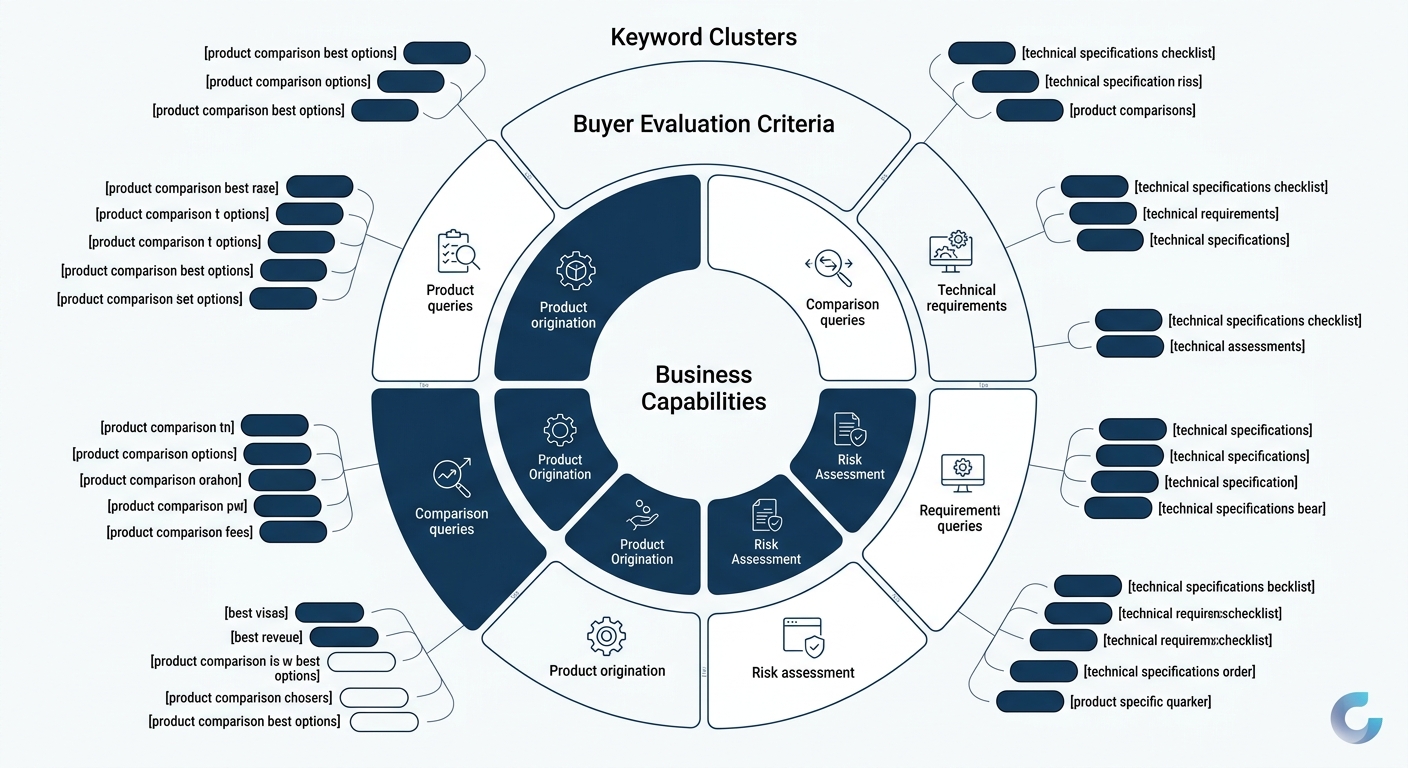
When your content team receives a brief, every piece traces back through three layers: what the business delivers, how buyers evaluate it, and what they search to conduct that evaluation.
Keyword Ownership Prevents the Authority Leak
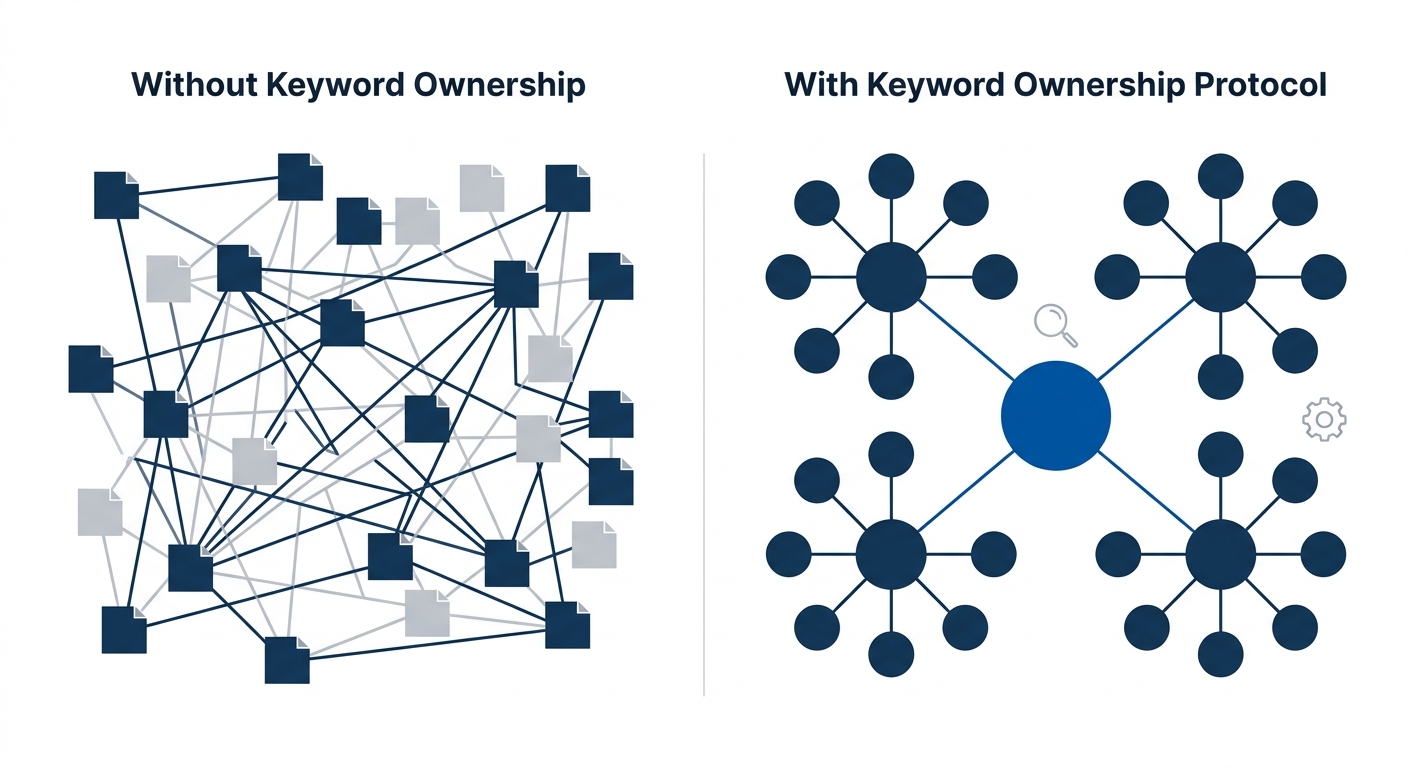
Even with a capability framework in place, enterprise SEO authority mapping collapses without governance. The 2026 enterprise SEO governance guidance from Fuel Online makes the mechanism explicit: “one designated primary page per keyword cluster, with all supporting content linking back to it.” Build separate topical authority maps per business area, then identify cross-unit linking opportunities to construct entity-level authority across the full organization.
This is a structural requirement driven by how search engines now evaluate authority. Google’s E-E-A-T framework, reinforced through the March 2026 and May 2026 core updates, rewards domains that demonstrate clear topical ownership. A domain where four different pages target the same keyword cluster — each from a different business unit, each with different internal link structures — signals fragmentation rather than expertise.
The practical governance model breaks down like this:
| Component | What It Controls | Who Owns It |
|---|---|---|
| Capability map | Which business capabilities get SEO investment | VP Marketing / CMO |
| Keyword ownership registry | Which URL owns each cluster’s primary position | SEO team lead |
| Content brief template | How each piece connects to capability + cluster | Content strategy |
| Internal link protocol | How supporting pages pass authority to primary pages | SEO + web development |
| Pipeline attribution layer | How content influence maps to CRM stage progression | Marketing ops |
When your agency partner builds this structure, the keyword ownership registry becomes the single most important deliverable. It’s the document that prevents two product teams from independently commissioning content that competes for the same SERP. And it’s what allows the internal linking architecture to function as designed — every supporting piece pointing authority toward the designated primary page, rather than scattering link equity across competing URLs.
The authority leak problem compounds over time. An enterprise site publishing 200+ pages per quarter without keyword ownership will, within 18 months, have dozens of internal cannibalization conflicts that suppress the very pages most likely to drive pipeline. We’ve covered how site architecture breakdowns erode organic revenue in detail, and keyword ownership is the upstream fix that prevents those breakdowns from forming in the first place.
Pipeline Measurement Replaces Traffic Reporting
The third piece of evidence for capability-first SEO is the measurement shift it enables. When every content asset maps to a business capability and a defined pipeline segment, you stop reporting on traffic and start reporting on influenced pipeline.
This matters because the attribution models that most enterprises run systematically undervalue organic search’s contribution to pipeline. Last-click attribution gives credit to the demo request page, not to the evaluation-stage content that brought a prospect into the vendor consideration set three weeks earlier. A capability-mapped content program fixes this by defining, in advance, which CRM stages each content cluster is designed to influence.
The measurement framework connects four data points: the content asset, the business capability it maps to, the keyword cluster it targets, and the CRM stage progression of contacts who engaged with it. You’re tracking whether content mapped to the “risk assessment” capability cluster is accelerating prospects from MQL to SQL in the commercial lending pipeline — a metric the CFO will fund.
Tip: When evaluating an agency’s authority mapping deliverable, ask for the capability-to-pipeline attribution layer. If the proposal stops at keyword clusters and content calendars without connecting to CRM stage data, the gap between traffic dashboards and board-level reporting will persist.
This approach also changes how you evaluate content performance mid-quarter. Instead of asking “is this page ranking?” you ask “are contacts who engage with this capability cluster progressing through pipeline stages faster than those who don’t?” The former question optimizes for vanity metrics. The latter optimizes for the revenue goals that justify the entire SEO investment.
Teams rebuilding their enterprise SEO strategy for AI-driven search need this measurement layer more than ever. As zero-click searches increase and AI Overviews absorb informational traffic, the volume of sessions originating from organic search will decline for many query types. The enterprises that maintain executive support for SEO will be the ones that tied their content programs to pipeline influence before the traffic numbers started shrinking.
The Claim, Reconsidered
The conventional enterprise SEO sequence — keyword research first, content strategy second, revenue attribution as an afterthought — persists because keyword tools are easy to operate and traffic dashboards are easy to read. The SEO business capability framework described here requires more upfront work: mapping business capabilities, defining buyer evaluation criteria, building a keyword ownership registry, and connecting content performance to CRM pipeline data.
That upfront work is precisely what separates enterprise SEO programs that survive quarterly budget reviews from ones that get absorbed into “brand” budgets or defunded entirely. The crawl budget and technical SEO foundation matters, and nobody disputes that. But the structural gap most enterprise programs need to close sits above the technical layer, in the space between what the business actually sells and what the content team actually publishes. Enterprise SEO authority mapping fills that gap. And the organizations that build the capability layer first will find that their keyword research, content production, and performance measurement all become easier to execute — and harder for competitors to replicate.