2026 Digital Marketing Trends: What Actually Moves the Needle in the Philippines

2026 is a reset year for digital marketing. AI is reshaping how people discover brands, short-form video continues to dominate attention, and search is increasingly a zero-click environment. The winners aren’t chasing every shiny new channel — they’re building systems that make their brands visible, credible, and conversion-ready across AI, search, social, and paid media.
Below is a practical, Philippines-ready breakdown of the 2026 digital marketing trends that matter most — plus what to do about them. We’re citing the best current research (Google, Semrush, WordStream, Social Media Today) and translating it into action.
At-a-glance: What’s changing in 2026
- AI search is reducing clicks — visibility now means being cited, not just ranked (Semrush).
- Short‑form video remains the biggest attention driver — Reels, Shorts, TikTok are now default discovery engines (Social Media Today).
- AI is shifting from tool to operating system — automation, personalization, and content velocity now require AI in the workflow (WordStream).
- Search experiences are changing — Google highlights AI Mode, generative search, and multimodal discovery (Google Think).
2026 Digital Marketing Trends (and what to do about each)
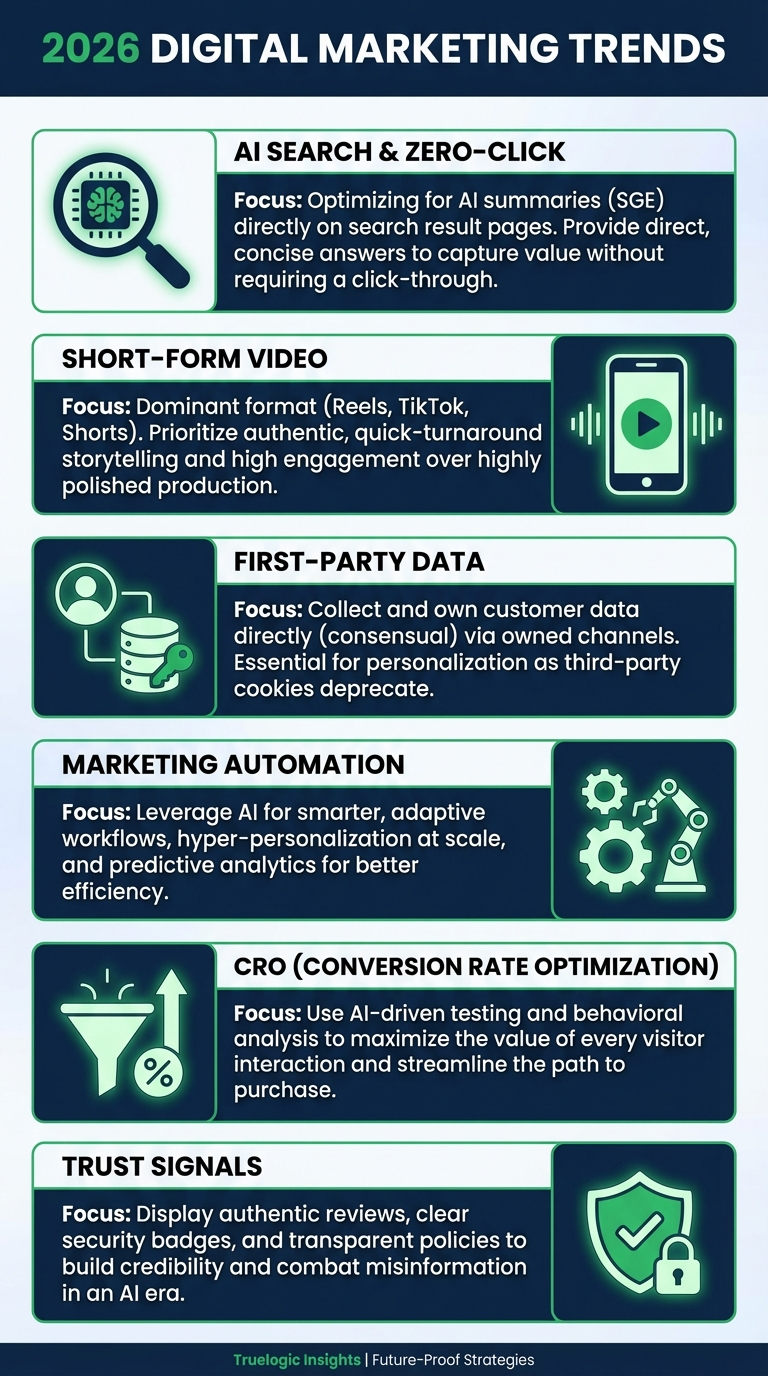
1) Generative search & zero‑click visibility
AI Overviews and conversational search continue to reduce click‑throughs. Semrush reports that roughly 60% of searches now result in no click, and AI Overviews are visible to billions of users (Semrush AI SEO Statistics).
What to do: Structure your content for AI citation and clarity. Prioritize expert answers, schema, and page-level authority. Invest in SEO services, technical SEO, and link building to earn trust signals.
2) AI‑assisted marketing operations
WordStream highlights that AI in 2026 is moving from experimentation to operating layer — marketers now automate testing, personalization, and optimization at scale (WordStream).
What to do: Use AI for content repurposing, predictive insights, and testing velocity, but keep human strategy and brand voice at the top. Build an AI‑ready stack that complements content marketing and email marketing.
3) Short‑form video dominance
Social Media Today reports that short‑form video is still the primary attention channel, with Reels and Shorts driving outsized engagement (Social Media Today).
What to do: Short‑form should be a core part of your 2026 plan. Use strong hooks, focus on micro‑education, and repackage blog content into short clips. Pair this with social media marketing and Facebook ads to amplify reach.
4) Generative engine optimization (GEO)
Google emphasizes that consumers now search across text, images, and voice, and they expect AI to understand intent — not just keywords (Google Think).
What to do: Build content ecosystems, not single posts. Use pillar pages, linked clusters, and multimedia. Ensure your service pages (like SEM and Google Ads) are clear, structured, and consistently updated.
5) Performance creative testing at scale
2026 winners will run rapid creative testing loops — especially for paid search and paid social. AI enables faster ideation, but measurement still determines the real winners.
What to do: Pair creative testing with landing page optimization and CRO. Invest in conversion rate optimization and measure with clear KPIs (see digital marketing KPIs).
6) First‑party data & privacy‑safe targeting
As targeting becomes more restricted, marketers rely on first‑party data, email lists, and on‑site behavior to guide personalization. AI helps segment and tailor offers, but the data must come from you.
What to do: Build stronger lead capture flows, email lifecycle campaigns, and content opt‑ins. If you need a content‑driven capture strategy, start with a content marketing program and combine it with email marketing automation.
7) Multi‑platform content repurposing
2026 favors teams that can turn one strong idea into many formats — blog, video, carousel, short, and email — without rewriting from scratch.
What to do: Build a core content engine. See how we do this in content calendars and platform‑specific planning. Support it with social media marketing and content marketing.
8) Local search remains a revenue driver
Even with AI search, local results still drive high‑intent actions. Businesses that keep listings, service areas, and review signals consistent will win visibility.
What to do: Strengthen local SEO, structured service pages, and local reviews. This supports your broader SEO strategy and improves discoverability in AI‑assisted local search.
9) Conversion rate optimization is now mandatory
When traffic becomes harder to win, conversion matters more. CRO is no longer an optional phase — it’s a core system.
What to do: Run CRO audits and continuous A/B testing. For a full framework, see our CRO guide and connect it with CRO services.

10) Brand trust & credibility signals
AI answers increasingly favor sources with credibility signals (clear author identity, consistent claims, and verified business information). Trust is now a ranking factor across AI and traditional search.
What to do: Build authority through expert content, testimonials, and consistent citations. This supports both SEO and long‑term brand demand.
Recommended next steps for Philippine businesses
- Audit your visibility in AI search and AI Overviews.
- Build a short‑form content engine tied to measurable KPIs.
- Invest in conversion rate optimization to increase ROI from shrinking traffic.
- Prioritize trust signals (reviews, case studies, expert content).
Want help implementing these trends?
Truelogic helps brands execute 2026‑ready strategies across SEO, paid media, content, CRO, and social. Explore our core services or reach out for a strategy call.